Earth

A Year After Sandy, Do You Approach Disaster Differently? 230

A year ago today, Superstorm Sandy struck the northeastern U.S. The storm destroyed homes — in some cases entire neighborhoods — and brought unprecedented disruptions to the New York City area's infrastructure, interrupting transportation, communications, and power delivery. It even damaged a Space Shuttle. In the time since, the U.S. hasn't faced a storm with Sandy's combination of power and placement, but businesses have had some time to rethink how much trust they can put in even seemingly impregnable data centers and other bulwarks of modernity: a big enough storm can knock down nearly anything. Today, parts of western Europe are recovering from a major storm as well: more than a dozen people were killed as the predicted "storm of the century" hit London, Amsterdam, and other cities on Sunday and Monday. In Amsterdam, the city's transportation system took a major hit; some passengers had to shelter in place in stopped subway cars while the storm passed. Are you (or your employer) doing anything different in the post-Sandy era, when it comes to preparedness to keep people, data, and equipment safe?
Displays

210 Degrees of Heads-Up Display: Hands-On With the InfinitEye 80

First time accepted submitter muterobert writes "InfinitEye is a prototype head mounted display that uses dual 1280×800 displays to create a massive 210 degree field of view. I traveled to Toulouse, France to be the first journalist in the world to go hands-on with the unit. These are my thoughts on the trip, the team, and the HMD itself. 'Natural and Panoramic Virtual Reality' is the best phrase I can come up with that summarises the InfinitEye's capabilities. If using the Oculus Rift is like opening the sunroof on a virtual world, the InfinitEye takes the roof clean off — at least if you base your opinion solely on horizontal FOV. But the new HMD also offers 1280×800 per eye in comparison the current Oculus Rift Dev Kit's 640×800 (and only slightly fewer pixels per eye than the Oculus Rift HD prototype)."
Cellphones

Leak: Almost a Third of Samsung Galaxy Gear Smartwatches Are Being Returned 365

llebeel writes "Almost a third of Samsung's Galaxy Gear Smartwatches sold are being returned, a leaked document has revealed, which shows that over 30 percent are being returned after sale at Best Buy locations in the US. The higher than expected return rate could be due to that realisation, with customers impulse buying and then realising that the smartwatch isn't everything it's cracked up to be." I'd like to hear from more people with smart watches who are happy with them, to better understand the appeal.
Cellphones

Motorola's "Project Ara" Will Allow Users To Customize Their Smartphones 112

rtoz writes "Motorola has announced 'Project Ara,' afree and open hardware platform for smartphones. The purpose of Project Ara is to create a modular smartphone that would allow users to swap hardware components according their own wish. The design for Project Ara consists of an endoskeleton (endo) and modules. The endo is the structural frame that holds all the modules in place. A module can be anything, from a new application processor to a new display or keyboard, an extra battery, a pulse oximeter — or something not yet thought of." Motorola's not the first one to think of such a thing; this project is in cooperation with Phonebloks, which had already been pushing for reusable, reconfigurable phone components.
iMac

Apple 27-inch iMac With Intel's Haswell Inside Tested 241

MojoKid writes "Apple's late 2013 edition iMacs are largely unchanged in external form, though they're upgraded in function with a revamped foundation that now pairs Intel's Haswell 4th Generation Core processors with NVIDIA's GeForce 700 Series graphics. The Cupertino company also outfitted these latest models with faster flash storage options, including support for PCI-E based storage, and 802.11ac Wi-Fi technology, all wrapped in a 21.5-inch (1920x1080) or 27-inch IPS displays with a 2560x1440 resolution. As configured, the 27-inch iMac reviewed here bolted through benchmarks with relative ease and posted especially solid figures in gaming tests, including a 3DMark 11 score of 3,068 in Windows 7 (via Boot Camp). Running Cinebench 11.5 in Mac OS X 10.9 Mavericks also helped showcase the CPU and GPU combination. Storage benchmarks weren't nearly as impressive though, for iMacs based on standard spinning media. For real IO throughput, it's advisable to go with Apple's Flash storage options."
Businesses

Hardware Is Now Open (sourced) For Business 42

ptorrone writes "CNBC has an interesting article about the growing trend of hardware companies going open-source. 'The open-source hardware movement is migrating from the garage to the marketplace. Companies that follow an open-source philosophy make their physical designs and software code available to the public. By doing so, these companies engage a wave of makers, hobbyists and designers who don't just want to buy products, but have a hand in developing them.'"
Power

Stung By Scandal, South Korea Weighs Up Cost of Curbing Nuclear Power 200

mdsolar writes in about an ongoing scandal in South Korea that has rocked their nuclear power program. "It started with a few bogus safety certificates for cables shutting a handful of South Korean nuclear reactors. Now, the scandal has snowballed, with 100 people indicted and Seoul under pressure to rethink its reliance on nuclear power. A shift away from nuclear, which generates a third of South Korea's electricity, could cost tens of billions of dollars a year by boosting imports of liquefied natural gas, oil or coal. Although helping calm safety concerns, it would also push the government into a politically sensitive debate over whether state utilities could pass on sharply higher power bills to households and companies. Gas, which makes up half of South Korea's energy bill while accounting for only a fifth of its power, would likely be the main substitute for nuclear, as it is considered cleaner than coal and plants can be built more easily near cities."
AMD

AMD's Radeon R9 290X Review 212

Billly Gates writes "AMD may have trouble in their CPU department with Intel having superior fabrication plants. However, in the graphics market with GPU chips AMD is doing well. AMD earned a very rare Elite reward from Tomshardware as the fastest GPU available with its fastest r9 for as little as $550 each. NVidia has its top end GPU cards going for $1,000 as it had little competition to worry about. Maximum PC also included some benchmarks and crowned ATI as the fastest and best value card available. AMD/ATI also has introduced MANTLE Api for lower level access than DirectX which is cross platform. This may turn into a very important API as AMD/ATI have their GPUs in the next generation Sony and Xbox consoles as well with a large marketshare for game developers to target"
AMD

AMD's Radeon R9 290X Launched, Faster Than GeForce GTX 780 For Roughly $100 Less 157

MojoKid writes "AMD has launched their new top-end Radeon R9 290X graphics card today. The new flagship wasn't ready in time for AMD's recent October 8th launch of midrange product, but their top of the line model, based on the GPU codenamed Hawaii, is ready now. The R9 290 series GPU (Hawaii) is comprised of up to 44 compute units with a total of 2,816 IEEE-2008 compliant shaders. The GPU has four geometry processors (2x the Radeon HD 7970) and can output 64 pixels per clock. The Radeon R9 290X features 2816 Stream Processors and an engine clock of up to 1GHz. The card's 4GB of GDDR5 memory is accessed by the GPU via a wide 512-bit interface and the R290X requires a pair of supplemental PCIe power connectors—one 6-pin and one 8-pin. Save for some minimum frame rate and frame latency issues, the new Radeon R9 290X's performance is impressive overall. AMD still has some obvious driver tuning and optimization to do, but frame rates across the board were very good. And though it wasn't a clean sweep for the Radeon R9 290X versus NVIDIA's flagship GeForce GTX 780 or GeForce GTX Titan cards, AMD's new GPU traded victories depending on the game or application being used, which is to say the cards performed similarly."
Input Devices

Patent Filing Reveals Samsung's Designs For Google Glass Competitor 39

rjmarvin writes "A South Korean patent filing, complete with memos and device designs has let the cat out of the bag about Samsung's new head-mounted wearable device to compete with Google Glass, two days after Microsoft was found to be testing a similar prototype. The device isn't wireless; in fact it has an attached USB extension to plug into and serve as an extension of a smartphone. The device is categorized as 'sports glasses' to 'take phone calls and listen to music during workouts.' The filing gives an overhead, front, and side view of the proposed device, another entry into the rapidly expanding and increasingly competitive wearables marketplace."
Microsoft

Microsoft Makes It Harder To Avoid Azure 164

itwbennett writes "Earlier this week, Microsoft rolled out a handful of hybrid cloud services that make it easy for businesses to start using Azure in a small way. What struck blogger Nancy Gohring about the announcement was 'how deeply Microsoft is integrating Azure into other products,' with the intention of moving long-time customers onto Azure in ways that are hardly perceptible to them."
Security

IZON IP Cameras Riddled With Security Flaws 55

An anonymous reader writes "With recent action by the FTC against TRENDnet, the 'Internet of Things' has taken a sharp turn in the eyes of the public and government with regard to security. This week, Duo Security employee Mark Stanislav presented security research he did on the IZON IP camera from Stem Innovation. Through his testing, Mark found hardcoded credentials for Linux accounts (accessible by Telnet; Yes, — really), an undocumented web interface allowing for viewing a camera's stream (also with hardcoded credentials, user/user), and a variety of other failings including a lack of cryptography in most of the camera's functionality, including when uploading videos to Amazon Web Services's S3 storage." According to the above-linked article, "Contacted by The Security Ledger, Stem Innovation CTO Matt McBeth said that the IZON firmware, server system and iOS applications tested by Stanislav have since been updated, and that the research contains “inaccurate and misleading information.” Stem did not provide specific information about any inaccuracies."
Displays

4K Ultra HD Likely To Repeat the Failure of 3D Television 559

New submitter tvf_trp writes "Fox Sports VP Jerry Steinbers has just announced that the broadcaster is not looking to implement 4K broadcasting (which offers four times the resolution of today's HD), stating that 4K Ultra HD is a 'monumental task with not a lot of return.' Digital and broadcasting specialists have raised concerns about the future of 4K technology, drawing parallels with the 3D's trajectory, which despite its initial hype has failed to establish a significant market share due to high price and lack of 3D content. While offering some advantages over 3D (no need for specs, considerable improvement in video quality, etc), 4K's prospects will remain precarious until it can get broadcasters and movie makers on board."
Power

Researchers Tout Electricity Storage Tech That Could Recharge Devices In Minutes 31

coondoggie writes "Vanderbilt University researchers say they have come up with a way to store electricity on a silicon-based supercapacitor that would let mobile phones recharge in seconds and let them continue to operate for weeks without recharging. The Vanderbilt team said they used porous silicon -- a material with a controllable and well-defined nanostructure made by electrochemically etching the surface of a silicon wafer. This let them create surfaces with optimal nanostructures for supercapacitor electrodes, but it left them with a major problem: Silicon is generally considered unsuitable for use in supercapacitors because it reacts readily with some of chemicals in the electrolytes that provide the ions that store the electrical charge, the researchers said."
Graphics

Next-Gen GPU Progress Slowing As It Aims for 20 nm and Beyond 91

JoshMST writes "Why are we in the middle of GPU-renaming hell? AMD may be releasing a new 28-nm Hawaii chip in the next few days, but it is still based on the same 28-nm process that the original HD 7970 debuted on nearly two years ago. Quick and easy (relative terms) process node transitions are probably a thing of the past. 20-nm lines applicable to large ASICs are not being opened until mid-2014. 'AMD and NVIDIA will have to do a lot of work to implement next generation features without breaking transistor budgets. They will have to do more with less, essentially. Either that or we will just have to deal with a much slower introduction of next generation parts.' It's amazing how far the graphics industry has come in the past 18 years, but the challenges ahead are greater than ever."
Power

Silicon Supercapacitor Promises Built-in Energy Storage For Electronic Devices 95

Science_afficionado writes "A news release from Vanderbilt University begins, 'Solar cells that produce electricity 24/7, not just when the sun is shining. Mobile phones with built-in power cells that recharge in seconds and work for weeks between charges. These are just two of the possibilities raised by a novel supercapacitor design invented by material scientists ... that is described in a paper published in the Oct. 22 issue of the journal Scientific Reports. It is the first supercapacitor that is made out of silicon so it can be built into a silicon chip along with the microelectronic circuitry that it powers. In fact, it should be possible to construct these power cells out of the excess silicon that exists in the current generation of solar cells, sensors, mobile phones and a variety of other electromechanical devices, providing a considerable cost savings. ... Instead of storing energy in chemical reactions the way batteries do, “supercaps” store electricity by assembling ions on the surface of a porous material. As a result, they tend to charge and discharge in minutes, instead of hours, and operate for a few million cycles, instead of a few thousand cycles like batteries.' The full academic paper is available online."
Transportation

Tesla CEO Elon Musk: Fuel Cells Are 'So Bull@%!#' 479

Frosty P sends this quote from AutoblogGreen: "Elon Musk is unafraid to speak his mind. Whether he's talking about other players in the electric vehicle space or sub-par reporting from The New York Times, this is a man with few filters. Musk says that fuel cells are not part of the solution that electric vehicles offer for giving up the hydrocarbon addiction. After commenting that the only reason some automakers are pursuing hydrogen technology is for marketing purposes, that lithium batteries are superior mass- and volume-wise for a given range, and that fuel cells are too expensive, Musk capped it all off with the safety issue. 'Oh god, a fuel cell is so bull@%!#,' Musk said. 'Hydrogen is quite a dangerous gas. You know, it's suitable for the upper stage of rockets, but not for cars,' he said."
Cellphones

LG Launches Its Firefox OS Phone Fireweb for $200 91

SmartAboutThings writes "LG has launched the Fireweb Firefox OS smartphone in a joint event with the Telefonica Vivo carrier. The Fireweb Firefox OS smartphone will be available for around $200 and will join the Alcatel One Touch Fire which Telfonia is launching in Brazil, starting today. Mexico, Peru, and Uruguay are the next countries to get it. The Fireweb smartphone is LG's very first Firefox OS device and it increases the small number of OEMs that have released Firefox OS devices on the market. The smartphone has a 4-inch screen with a 480 x 320 display, a 1GHz Qualcomm processor and 4GB internal storage that can be expanded with the microSD card slot by up to 32GB. It has a 5-megapixel cameras that comes with both autofocusing and an LED flash, which is a first for Firefox OS phones." Hopefully an OEM releases a Firefox OS phone with beefier hardware, but you can't argue with the price.
Graphics

Improved Image Quality For HMDs Like Oculus Rift 55

An anonymous reader writes "The combination of smartphone panels with relatively cheap and light-weight lenses enabled affordable wide-angle Head Mounted Displays like the Oculus Rift. However, these optics introduce distortions when viewing the image through the HMD. So far these have been compensated for in software by using post-processing pixel shaders that warp the image. However, by doing so a loss in image quality (sharpness) can be perceived. Now researchers from Intel found a way around this error by using different sampling for rendering, therefore potentially increasing the image quality of all current and future HMDs with a wide field of view." Rather than applying barrel distortion to the final raster image, the researchers warp the scene geometry during rasterization. However, it currently requires ray tracing so it's a bit computationally expensive. Note that a vertex transformation can be used (with tessellation used to enhance the approximation), but the results are of variable quality.
Printer

Ask Slashdot: Best SOHO Printer Choices? 381

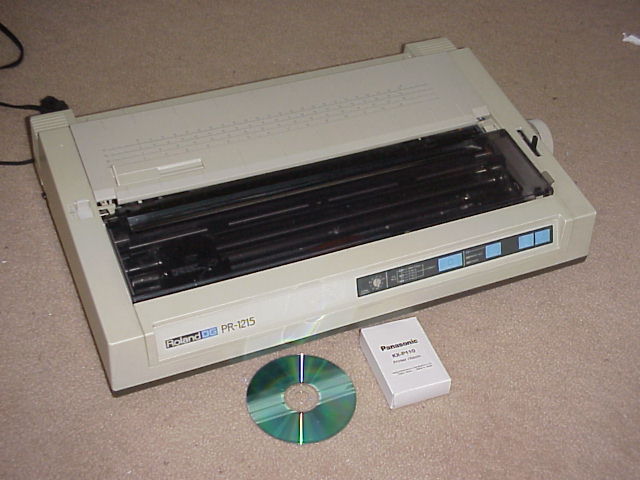
rueger writes "I can remember trading up from a daisy-wheel printer to dot matrix, and can remember when Jerry Pournelle used to say 'Buy the most expensive HP printer you can afford.' Mine was a 4P. Times have changed, though, and I'm looking for trustworthy advice before buying a couple of new printers. Specifically, a B&W Laser with sheet feed scanner, and a color inkjet with a solid flatbed scanner for copying music. We want solid, reliable machines that will give a few years of small office service, that have reasonably cheap consumables, and that will "just work" with Windows and Linux. Network ready of course. Let me expand. These days there seems to be no market leader in printers — they tend to be cheap disposable items. Part of the reason is that it is hard to find any real user reviews of these machines — most of the comments on Best Buy or other sites are full of fanboy enthusiasm, or extreme negativity — nothing that can be relied on. Between those, and the sock puppets, and the astroturfing, there's nothing I'd trust. I do trust Slashdot, though, for things like this. People here are able to offer realistic advice and experience that can usually tell the story. So, I ask: who's making good printers these days?"

Slashdot Top Deals