Businesses

World-Beating 55,000% Surge in India AI Stock Fuels Bubble Fears (thehindubusinessline.com) 23

The world's best-performing stock is turning into a cautionary tale for investors chasing outsized returns from the AI boom. From a report: Little-known until recently even within its home market of India, RRP Semiconductor Ltd. became a social-media obsession as its shares surged more than 55,000% in the 20 months through Dec. 17 -- by far the biggest gain worldwide among companies with a market value above $1 billion.

That's despite posting negative revenue in its latest financial results, reporting just two full-time employees in its latest annual report, and boasting only a tenuous link to the semiconductor spending boom after shifting away from real estate in early 2024. A mix of online hype, a tiny free float and India's swelling base of retail investors drove 149 straight limit-up sessions, even as exchange officials and the company itself cautioned investors.

The rally is now showing signs of strain -- and regulators are taking a closer look. The Securities and Exchange Board of India has begun examining the surge in RRP's shares for potential wrongdoing, according to a person familiar with the matter who asked not to be identified discussing confidential information. The $1.7 billion stock, recently restricted by its exchange to trading just once a week, has fallen by 6% from its Nov. 7 peak.

Social Networks

Doublespeed Hack Reveals What Its AI-Generated Accounts Are Promoting (404media.co) 27

An anonymous reader quotes a report from 404 Media: Doublespeed, a startup backed by Andreessen Horowitz (a16z) that uses a phone farm to manage at least hundreds of AI-generated social media accounts and promote products has been hacked. The hack reveals what products the AI-generated accounts are promoting, often without the required disclosure that these are advertisements, and allowed the hacker to take control of more than 1,000 smartphones that power the company. The hacker, who asked for anonymity because he feared retaliation from the company, said he reported the vulnerability to Doublespeed on October 31. At the time of writing, the hacker said he still has access to the company's backend, including the phone farm itself.

"I could see the phones in use, which manager (the PCs controlling the phones) they had, which TikTok accounts they were assigned, proxies in use (and their passwords), and pending tasks. As well as the link to control devices for each manager," the hacker told me. "I could have used their phones for compute resources, or maybe spam. Even if they're just phones, there are around 1100 of them, with proxy access, for free. I think I could have used the linked accounts by puppeting the phones or adding tasks, but haven't tried."

As I reported in October, Doublespeed raised $1 million from a16z as part of its "Speedrun" accelerator program, "a fastpaced, 12-week startup program that guides founders through every critical stage of their growth." Doublespeed uses generative AI to flood social media with accounts and posts to promote certain products on behalf of its clients. Social media companies attempt to detect and remove this type of astroturfing for violating their inauthentic behavior policies, which is why Doublespeed uses a bank of phones to emulate the behavior of real users. So-called "click farms" or "phone farms" often use hundreds of mobile phones to fake online engagement of reviews for the same reason. [...] I've seen TikTok accounts operated by Doublespeed promote language learning apps, dating apps, a Bible app, supplements, and a massager.

Games

Netflix To Add Soccer Video Game Based On FIFA World Cup Next Year (reuters.com) 14

An anonymous reader quotes a report from Reuters: Netflix on Wednesday said it will add a soccer simulation title to its gaming portfolio, as the streaming giant looks to leverage the FIFA World Cup 2026 tournament to deepen its video game push. The soccer title will be developed and published by Delphi Interactive, which is also helping create a premium James Bond game called "007 First Light," and in association with the sport's governing body, FIFA. Netflix said the game will launch in time for the world's most-watched sporting event, scheduled to start June next year in the U.S.
Government

FCC Chair Suggests Agency Isn't Independent, Word Cut From Mission Statement (axios.com) 110

FCC Chairman Brendan Carr said in his Wednesday Senate testimony that the agency he governs "is not an independent agency, formally speaking." Axios: During his testimony, the word "independent" was removed from the FCC's mission statement on its website. The extraordinary statement speaks to a broader trend of regulatory agencies losing power to the executive branch during the Trump era. Last week, the Supreme Court appeared poised to allow President Trump to fire members of the Federal Trade Commission during oral arguments over the issue.

Sen. Ben Ray LujÃn (D-N.M.) began the line of questioning, citing the FCC's website, which said the agency was independent as of Wednesday morning. By Wednesday afternoon, the FCC's mission statement no longer said it was independent. Chairman Carr would not respond directly to questions about whether he believed the president was his boss. He would not answer whether it's appropriate if the president were to pressure him to go after media companies. He suggested the president has the power to fire him and other FCC commissioners.

Power

Senators Count the Shady Ways Data Centers Pass Energy Costs On To Americans (arstechnica.com) 53

U.S. senators are probing whether Big Tech data centers are driving up local electricity bills by socializing grid upgrade costs onto residents. Some of the tactics they're using include NDAs, shell companies, and lobbying. Ars Technica reports: In letters (PDF) to seven AI firms, Senators Elizabeth Warren (D-Mass.), Chris Van Hollen (D-Md.), and Richard Blumenthal (D-Conn.) cited a study estimating that "electricity prices have increased by as much as 267 percent in the past five years" in "areas located near significant data center activity." Prices increase, senators noted, when utility companies build out extra infrastructure to meet data centers' energy demands -- which can amount to one customer suddenly consuming as much power as an entire city. They also increase when demand for local power outweighs supply. In some cases, residents are blindsided by higher bills, not even realizing a data center project was approved, because tech companies seem intent on dodging backlash and frequently do not allow terms of deals to be publicly disclosed.

AI firms "ask public officials to sign non-disclosure agreements (NDAs) preventing them from sharing information with their constituents, operate through what appear to be shell companies to mask the real owner of the data center, and require that landowners sign NDAs as part of the land sale while telling them only that a 'Fortune 100 company' is planning an 'industrial development' seemingly in an attempt to hide the very existence of the data center," senators wrote. States like Virginia with the highest concentration of data centers could see average electricity prices increase by another 25 percent by 2030, senators noted. But price increases aren't limited to the states allegedly striking shady deals with tech companies and greenlighting data center projects, they said. "Interconnected and interstate power grids can lead to a data center built in one state raising costs for residents of a neighboring state," senators reported.

Under fire for supposedly only pretending to care about keeping neighbors' costs low were Amazon, Google, Meta, Microsoft, Equinix, Digital Realty, and CoreWeave. Senators accused firms of paying "lip service," claiming that they would do everything in their power to avoid increasing residential electricity costs, while actively lobbying to pass billions in costs on to their neighbors. [...] Particularly problematic, senators emphasized, were reports that tech firms were getting discounts on energy costs as utility companies competed for their business, while prices went up for their neighbors.

Advertising

Meta Tolerates Rampant Ad Fraud From China To Safeguard Billions In Revenue (reuters.com) 54

A Reuters investigation found that Meta knowingly tolerated large volumes of scam and illegal ads from China worth billions in revenue. Reuters reports: Though China's authoritarian government bans use of Meta social media by its citizens, Beijing lets Chinese companies advertise to foreign consumers on the globe-spanning platforms. As a result, Meta's advertising business was thriving in China, ultimately reaching over $18 billion in annual sales in 2024, more than a tenth of the company's global revenue. But Meta calculated that about 19% of that money -- more than $3 billion -- was coming from ads for scams, illegal gambling, pornography and other banned content, according to internal Meta documents reviewed by Reuters.

The documents are part of a cache of previously unreported material generated over the past four years by teams including Meta's finance, lobbying, engineering and safety divisions. The cache reveals Meta's efforts over that period to understand the scale of abuse on its platforms and the company's reluctance to introduce fixes that could undermine its business and revenues. The documents show that Meta believed China was the country of origin of roughly a quarter of all ads for scams and banned products on Meta's platforms worldwide. Victims ranged from shoppers in Taiwan who purchased bogus health supplements to investors in the United States and Canada who were swindled out of their savings. "We need to make significant investment to reduce growing harm," Meta staffers warned in an internal April 2024 presentation to leaders of its safety operations.

To that end, Meta created an anti-fraud team that went beyond previous efforts to monitor scams and other banned activity from China. Using a variety of stepped-up enforcement tools, it slashed the problematic ads by about half during the second half of 2024 -- from 19% to 9% of the total advertising revenue coming from China. Then Meta Chief Executive Mark Zuckerberg weighed in. "As a result of Integrity Strategy pivot and follow-up from Zuck," a late 2024 document notes, the China ads-enforcement team was "asked to pause" its work. Reuters was unable to learn the specifics of the CEO's involvement or what the so-called "Integrity Strategy pivot" entailed. But after Zuckerberg's input, the documents show, Meta disbanded its China-focused anti-scam team. It also lifted a freeze it had introduced on granting new Chinese ad agencies access to its platforms. One document shows that Meta shelved yet other anti-scam measures that internal tests had indicated would be effective. The document didn't detail the specifics of those measures.

Meta took these steps even as an outside consultant it hired produced research that warned "Meta's own behavior and policies" were fostering systemic corruption in the Chinese market for ads targeting users in other countries, additional documents show. The upshot: Within a few months of Meta's brief crackdown, a new crop of Chinese advertising agencies was flooding Facebook and Instagram with prohibited ads. By mid-2025, banned ads climbed back to about 16% of Meta's China revenue. Rob Leathern, who was a senior director of product management at Facebook until 2020 and is no longer at the company, said the scale of predatory advertising revealed in the documents represents a major breakdown in consumer protections at the social media giant. "The levels that you're talking about are not defensible," he said of the percentage of abusive ads. "I don't know how anyone could think this is okay."

Canada

Mark Carney Criticised For Using British Spellings In Canadian Documents (theguardian.com) 121

An anonymous reader quotes a report from the Guardian: Mark Carney says that amid a fundamental shift to the nature of globalization, his government will catalyze the growth in both the public and private sector. But Canadian linguists say that's a problem. Language experts have called out the Canadian prime minister's growing "utilization" of British spellings in key documents -- including the recent federal budget and a press release issued following a meeting with Donald Trump.

Carney, who served as the governor of the bank of England for seven years, appears to have run afoul of Canadian linguistic norms, returning to his home country with a penchant for using 's' instead of 'z'- a hallmark of British spellings. In an open letter (PDF) chastising the prime minister, six linguists have asked his office, the Canadian government and parliament to stick to Canadian English spelling, "which is the spelling they consistently used from the 1970s to 2025." They warned that if governments start to use other systems for spelling, "this could lead to confusion about which spelling is Canadian."

Canadian English is a source of immense pride for the nation's pedants. But the country's distinct and somewhat arbitrary spelling reflects the legacy of how Canada was colonized. "Canadian English evolved through Loyalist settlement after the American Revolutionary War, subsequent waves of English, Scottish, Welsh and Irish immigration, and from European and global contexts," the letter says, with the current accepted spellings of words reflecting "global influences and cultures from around the world represented in our population, as well as containing words and phrases from Indigenous languages." The linguists pointed out that Canada's distinct style of spelling was widespread in media and government documents, with this deliberate decision reflecting a desire to preserve a vital element of the country's "national history, identity and pride."

United States

US Threatens Penalties Against European Tech Firms Amid Regulatory Fight (nytimes.com) 112

U.S. officials excoriated the European Union for discriminating against American technology companies and threatened to penalize European tech companies in return, in a social media post on Tuesday. From a report: The pronouncement appeared to signal a rockier period for U.S.-E.U. trade relations, as the two governments work to finalize a trade framework they announced this year. The United States has been pushing Europe to open up its tech sector to American firms. But U.S. officials have complained that the European Union has not walked back broader regulation of company business practices while also proceeding with investigations of major American tech firms like Google, X, Amazon and Meta.

In a social media post, the Office of the United States Trade Representative, which has carried out the negotiations, said that the European Union and some member states had "persisted in a continuing course of discriminatory and harassing lawsuits, taxes, fines and directives" against American companies.

The United States had raised concerns with the European Union about these issues for years "without meaningful engagement," all while allowing European companies to operate freely in the United States, it said. If the European Union continues these policies, the United States would "have no choice but to begin using every tool at its disposal to counter these unreasonable measures," the U.S.T.R. said. It named fees and restrictions on service companies among the possibilities, and said it would use the same approach against other countries that echoed Europe's strategy.

The post singled out potential European service providers that could be targeted by name, listing Accenture, DHL, Mistral, SAP, Siemens and Spotify, among others.

Censorship

Russian Ban On Roblox Gaming Platform Sparks Rare Protest (reuters.com) 64

An anonymous reader quotes a report from Reuters: Several dozen people protested on Sunday in the Siberian city of Tomsk against Russia's ban on U.S. children's gaming platform Roblox, a rare show of public dissent as popular irritation over the ban gains some momentum. In wartime Russia, censorship is extensive: Moscow blocks or restricts social media platforms such as Snapchat, Facebook, Instagram, WhatsApp and YouTube while distributing its own narrative through a network of social media and Russian media. Russia's communications watchdog Roskomnadzor said on December 3 it had blocked Roblox because it was "rife with inappropriate content that can negatively impact the spiritual and moral development of children."

In Tomsk, 2,900 km (1,800 miles) east of Moscow, several dozen people braved the snow to hold up hand-drawn placards reading "Hands off Roblox" and "Roblox is the victim of the digital Iron Curtain" in Vladimir Vysotsky Park, according to photographs provided by an organizer of the protest. "Bans and blocks are all you are able to do," read one placard. The photographs showed about 25 people standing in a circle in the snow, holding up placards. In Russia, the ban on Roblox has triggered a debate over censorship, child safety in relation to technology and even the effectiveness of censorship in a digitalized world where children can bypass many bans in a few clicks.

AI

Are Warnings of Superintelligence 'Inevitability' Masking a Grab for Power? (noemamag.com) 183

Superintelligence has become "a quasi-political forecast" with "very little to do with any scientific consensus, emerging instead from particular corridors of power." That's the warning from James O'Sullivan, a lecturer in digital humanities from University College Cork. In a refreshing 5,600-word essay in Noema magazine, he notes the suspicious coincidence that "The loudest prophets of superintelligence are those building the very systems they warn against..."

"When we accept that AGI is inevitable, we stop asking whether it should be built, and in the furor, we miss that we seem to have conceded that a small group of technologists should determine our future." (For example, OpenAI CEO Sam Altman "seems determined to position OpenAI as humanity's champion, bearing the terrible burden of creating God-like intelligence so that it might be restrained.") The superintelligence discourse functions as a sophisticated apparatus of power, transforming immediate questions about corporate accountability, worker displacement, algorithmic bias and democratic governance into abstract philosophical puzzles about consciousness and control... Media amplification plays a crucial role in this process, as every incremental improvement in large language models gets framed as a step towards AGI. ChatGPT writes poetry; surely consciousness is imminent..." Such accounts, often sourced from the very companies building these systems, create a sense of momentum that becomes self-fulfilling. Investors invest because AGI seems near, researchers join companies because that's where the future is being built and governments defer regulation because they don't want to handicap their domestic champions...

We must recognize this process as political, not technical. The inevitability of superintelligence is manufactured through specific choices about funding, attention and legitimacy, and different choices would produce different futures. The fundamental question isn't whether AGI is coming, but who benefits from making us believe it is... We do not yet understand what kind of systems we are building, or what mix of breakthroughs and failures they will produce, and that uncertainty makes it reckless to funnel public money and attention into a single speculative trajectory.

Some key points:
  • "The machines are coming for us, or so we're told. Not today, but soon enough that we must seemingly reorganize civilization around their arrival..."
  • "When we debate whether a future artificial general intelligence might eliminate humanity, we're not discussing the Amazon warehouse worker whose movements are dictated by algorithmic surveillance or the Palestinian whose neighborhood is targeted by automated weapons systems. These present realities dissolve into background noise against the rhetoric of existential risk..."
  • "Seen clearly, the prophecy of superintelligence is less a warning about machines than a strategy for power, and that strategy needs to be recognized for what it is... "
  • "Superintelligence discourse isn't spreading because experts broadly agree it is our most urgent problem; it spreads because a well-resourced movement has given it money and access to power..."
  • "Academic institutions, which are meant to resist such logics, have been conscripted into this manufacture of inevitability... reinforcing industry narratives, producing papers on AGI timelines and alignment strategies, lending scholarly authority to speculative fiction..."
  • "The prophecy becomes self-fulfilling through material concentration — as resources flow towards AGI development, alternative approaches to AI starve..."
  • "The dominance of superintelligence narratives obscures the fact that many other ways of doing AI exist, grounded in present social needs rather than hypothetical machine gods..." [He lists data sovereignty movements "that treat data as a collective resource subject to collective consent," as well as organizations like Canada's First Nations Information Governance Centre and New Zealand's Te Mana Raraunga, plus "Global South initiatives that use modest, locally governed AI systems to support healthcare, agriculture or education under tight resource constraints."] "Such examples... demonstrate how AI can be organized without defaulting to the superintelligence paradigm that demands everyone else be sacrificed because a few tech bros can see the greater good that everyone else has missed..."
  • "These alternatives also illuminate the democratic deficit at the heart of the superintelligence narrative. Treating AI at once as an arcane technical problem that ordinary people cannot understand and as an unquestionable engine of social progress allows authority to consolidate in the hands of those who own and build the systems..."

He's ultimately warning us about "politics masked as predictions..."

"The real political question is not whether some artificial superintelligence will emerge, but who gets to decide what kinds of intelligence we build and sustain. And the answer cannot be left to the corporate prophets of artificial transcendence because the future of AI is a political field — it should be open to contestation.

"It belongs not to those who warn most loudly of gods or monsters, but to publics that should have the moral right to democratically govern the technologies that shape their lives."


Social Networks

Like Australia, Denmark Plans to Severely Restrict Social Media Use for Teenagers (apnews.com) 92

"As Australia began enforcing a world-first social media ban for children under 16 years old this week, Denmark is planning to follow its lead," reports the Associated Press, "and severely restrict social media access for young people." The Danish government announced last month that it had secured an agreement by three governing coalition and two opposition parties in parliament to ban access to social media for anyone under the age of 15. Such a measure would be the most sweeping step yet by a European Union nation to limit use of social media among teens and children.

The Danish government's plans could become law as soon as mid-2026. The proposed measure would give some parents the right to let their children access social media from age 13, local media reported, but the ministry has not yet fully shared the plans... [A] new "digital evidence" app, announced by the Digital Affairs Ministry last month and expected to launch next spring, will likely form the backbone of the Danish plans. The app will display an age certificate to ensure users comply with social media age limits, the ministry said.

The article also notes Malaysia "is expected to ban social media accounts for people under the age of 16 starting at the beginning of next year, and Norway is also taking steps to restrict social media access for children and teens.

"China — which manufacturers many of the world's digital devices — has set limits on online gaming time and smartphone time for kids."
GUI

System76 Launches First Stable Release of COSMIC Desktop and Pop!_OS 24.04 LTS (9to5linux.com) 23

This week System76 launched the first stable release of its Rust-based COSMIC desktop environment. Announced in 2021, it's designed for all GNU/Linux distributions — and it shipping with Pop!_OS 24.04 LTS (based on Ubuntu 24.04 LTS).

An anonymous reader shared this report from 9to5Linux: Previous Pop!_OS releases used a version of the COSMIC desktop that was based on the GNOME desktop environment. However, System76 wanted to create a new desktop environment from scratch while keeping the same familiar interface and user experience built for efficiency and fun. This means that some GNOME apps have been replaced by COSMIC apps, including COSMIC Files instead of Nautilus (Files), COSMIC Terminal instead of GNOME Terminal, COSMIC Text Editor instead of GNOME Text Editor, and COSMIC Media Player instead of Totem (Video Player).

Also, the Pop!_Shop graphical package manager used in previous Pop!_OS releases has now been replaced by a new app called COSMIC Store.

"If you're ambitious enough, or maybe just crazy enough, there eventually comes a time when you realize you've reached the limits of current potential, and must create something completely new if you're to go further..." explains System76 founder/CEO Carl Richell: For twenty years we have shipped Linux computers. For seven years we've built the Pop!_OS Linux distribution. Three years ago it became clear we had reached the limit of our current potential and had to create something new. Today, we break through that limit with the release of Pop!_OS 24.04 LTS with the COSMIC Desktop Environment. Today is special not only in that it's the culmination of over three years of work, but even more so in that System76 has built a complete desktop environment for the open source community... I hope you love what we've built for you. Now go out there and create. Push the limits, make incredible things, and have fun doing it!
GNU is Not Unix

'Free Software Awards' Winners Announced: Andy Wingo, Alx Sa, Govdirectory (fsf.org) 5

This week the Free Software Foundation honored Andy Wingo, Alx Sa, and Govdirectory with this year's annual Free Software Awards (given to community members and groups making "significant" contributions to software freedom): Andy Wingo is one of the co-maintainers of GNU Guile, the official extension language of the GNU operating system and the Scheme "backbone" of GNU Guix. Upon receiving the award, he stated: "Since I learned about free software, the vision of a world in which hackers freely share and build on each others' work has been a profound inspiration to me, and I am humbled by this recognition of my small efforts in the context of the Guile Scheme implementation. I thank my co-maintainer, Ludovic Courtès, for his comradery over the years: we are just building on the work of the past maintainers of Guile, and I hope that we live long enough to congratulate its many future maintainers."

The 2024 Award for Outstanding New Free Software Contributor went to Alx Sa for work on the GNU Image Manipulation Program (GIMP). When asked to comment, Alx responded: "I am honored to receive this recognition! I started contributing to the GNU Image Manipulation Program as a way to return the favor because of all the cool things it's allowed me to do. Thanks to the help and mentorship of amazing people like Jehan Pagès, Jacob Boerema, Liam Quin, and so many others, I hope I've been able to help other people do some cool new things, too."

Govdirectory was presented with this year's Award for Projects of Social Benefit, given to a project or team responsible for applying free software, or the ideas of the free software movement, to intentionally and significantly benefit society. Govdirectory provides a collaborative and fact-checked listing of government addresses, phone numbers, websites, and social media accounts, all of which can be viewed with free software and under a free license, allowing people to always reach their representatives in freedom...

The FSF plans to further highlight the Free Software Award winners in a series of events scheduled for the new year to celebrate their contributions to free software.

Television

Arkansas Becoming 1st State To Sever Ties With PBS, Effective July 1 (apnews.com) 118

joshuark writes: Arkansas is becoming the first state to officially end its public television affiliation with PBS. The Arkansas Educational Television Commission, whose members are all appointed by the governor, voted to disaffiliate from PBS effective July 1, 2026, citing the $2.5 million annual membership dues as "not feasible." The decision was also driven by the loss of a similar amount in federal funding after the Corporation for Public Broadcasting (CPB) was defunded by Congress.

PBS Arkansas is rebranding itself as Arkansas TV and will provide more local content, the agency's Executive Director and CEO Carlton Wing said in a statement. Wing, a former Republican state representative, took the helm of the agency in September. "Public television in Arkansas is not going away," Wing said. "In fact, we invite you to join our vision for an increased focus on local programming, continuing to safeguard Arkansans in times of emergency and supporting our K-12 educators and students."

"The commission's decision to drop PBS membership is a blow to Arkansans who will lose free, over the air access to quality PBS programming they know and love," a PBS spokesperson wrote in an email to The Associated Press. The demise of the Corporation for Public Broadcasting, is a direct result of President Donald Trump's targeting of public media, which he has repeatedly said is spreading political and cultural views antithetical to those the United States should be espousing. Trump denied taking a big should on television viewers.

United States

'Apple Tax is Dead in the USA' (arstechnica.com) 100

The Ninth Circuit Court of Appeals has almost entirely upheld a scathing April ruling that found Apple in willful violation of a 2021 injunction meant to open up iOS App Store payments in its long-running legal battle against Epic Games. A three-judge panel affirmed that Apple's 27% fee for developers using outside payment options had a "prohibitive effect" and that the company's design restrictions on external payment links were overly broad.

The appeals court also agreed that Apple acted in "bad faith" by rejecting viable, compliant alternatives in internal discussions. One divergence from the lower court: the appeals court ruled that Apple should still be able to charge a "reasonable fee" based on its actual costs to ensure user security and privacy, rather than charging nothing at all. What qualifies as "reasonable" remains to be determined.

Epic CEO Tim Sweeney told reporters he believes those fees should be "super super minor," on the order of "tens or hundreds of dollars" every time an iOS app update goes through Apple for review. "The Apple Tax is dead in the USA," he wrote on social media. Sweeney also alleged that a widespread "fear of retaliation" has kept many developers paying Apple's default 30% fees, claiming the company can effectively "ghost" apps by delaying reviews or burying them in search results.
Australia

Reddit Launches High Court Challenge To Australia's Under-16s Social Media Ban (theguardian.com) 54

An anonymous reader quotes a report from the Guardian: Reddit has filed a challenge against Australia's under-16s social media ban in the high court, lodging its case two days after implementing age restrictions on its website. The company said in a Reddit post on Friday that while it agreed with protecting people under 16, the law "has the unfortunate effect of forcing intrusive and potentially insecure verification processes on adults as well as minors, isolating teens from the ability to engage in age-appropriate community experiences."

Reddit said there was an "illogical patchwork" of platforms included in the ban. "As the Australian Human Rights Commission put it, 'There are less restrictive alternatives available that could achieve the aim of protecting children and young people from online harms, but without having such a significant negative impact on other human rights.'" Reddit argued it was a forum primarily for adults without the traditional social media features the government has "taken issue with."

Reddit was challenging the law on the grounds it infringed on the implied freedom of political communication. It was also seeking to challenge whether Reddit could be considered an age-restricted social media platform under the legislation. It said it was not seeking to challenge the law to avoid compliance, and had implemented age-assurance measures since Wednesday. The company said the vast majority of Redditors were adults, and advertising wasn't targeted to children under 18. The Apple app store age rating for Reddit is 17+. "Despite the best intentions, this law is missing the mark on actually protecting young people online," Reddit said. "So, while we will comply with this law, we have a responsibility to share our perspective and see that it is reviewed by the courts."

United States

US Could Ask Foreign Tourists For Five-Year Social Media History Before Entry (bbc.com) 270

Tourists from dozens of countries including the UK could be asked to provide a five-year social media history as a condition of entry to the United States, under a new proposal unveiled by American officials. From a report: The new condition would affect people from dozens of countries who are eligible to visit the US for 90 days without a visa, as long as they have filled out an Electronic System for Travel Authorization (ESTA) form. Since returning to the White House in January, President Donald Trump has moved to toughen US borders more generally - citing national security as a reason.

Analysts say the new plan could pose an obstacle to potential visitors, or harm their digital rights. Asked whether the proposal could lead to a steep drop-off in tourism to the US, Trump said he was not concerned. "No. We're doing so well," the president said on Wednesday. "We just want people to come over here, and safe. We want safety. We want security. We want to make sure we're not letting the wrong people come enter our country."

Social Networks

Operation Bluebird Wants To Relaunch 'Twitter' For a New Social Network (theverge.com) 83

A startup called Operation Bluebird is petitioning the US Patent and Trademark Office to strip X Corp of the "Twitter" and "tweet" trademarks, hoping to relaunch a new Twitter with the old brand, bird logo, and "town square" vibe. "The TWITTER and TWEET brands have been eradicated from X Corp.'s products, services, and marketing, effectively abandoning the storied brand, with no intention to resume use of the mark," the petition states. "The TWITTER bird was grounded." Ars Technica reports: If successful, two leaders of the group tell Ars, Operation Bluebird would launch a social network under the name Twitter.new, possibly as early as late next year. (Twitter.new has created a working prototype and is already inviting users to reserve handles.)

Michael Peroff, an Illinois attorney and founder of Operation Bluebird, said that in the intervening years, more Twitter-like social media networks have sprung up or gained traction -- like Threads, Mastodon, and Bluesky. But none have the scale or brand recognition that Twitter did prior to Musk's takeover. "There certainly are alternatives," Peroff said. "I don't know that any of them at this point in time are at the scale that would make a difference in the national conversation, whereas a new Twitter really could."

Similarly, Peroff's business partner, Stephen Coates, an attorney who formerly served as Twitter's general counsel, said that Operation Bluebird aims to recreate some of the magic that Twitter once had. "I remember some time ago, I've had celebrities react to my content on Twitter during the Super Bowl or events," he told Ars. "And we want that experience to come back, that whole town square, where we are all meshed in there."
"Mere 'token use' won't be enough to reserve the mark," said Mark Lemley, a Stanford Law professor and expert in trademark law. "Or [X] could defend if it can show that it plans to go back to using Twitter. Consumers obviously still know the brand name. It seems weird to think someone else could grab the name when consumers still associate it with the ex-social media site of that name. But that's what the law says."
AI

Adobe Integrates With ChatGPT 20

Adobe is integrating Photoshop, Express, and Acrobat directly into ChatGPT so users can edit photos, design graphics, and tweak PDFs through the chatbot. The Verge reports: The Adobe apps are free to use, and can be activated by typing the name of the app alongside an uploaded file and conversational instruction, such as "Adobe Photoshop, help me blur the background of this image." ChatGPT users won't have to specify the name of the app again during the same conversation to make additional changes. Depending on the instructions, Adobe's apps may offer a selection of results to choose from, or provide a UI element that the user can manually control -- such as Photoshop sliders for adjusting contrast and brightness.

The ChatGPT apps don't provide the full functionality of Adobe's desktop software. Adobe says the Photoshop app can edit specific sections of images, apply creative effects, and adjust image settings like brightness, contrast and exposure. Acrobat in ChatGPT can edit existing PDFs, compress and convert other documents into a PDF format, extract text or tables, and merge multiple files together.

The Adobe Express app allows ChatGPT users to both generate and edit designs, such as posters, invitations, and social media graphics. Everything in the design can be edited without leaving ChatGPT, from replacing text or images, to altering colors and animating specific sections. If ChatGPT users do want more granular control over a project they started in the chatbot, those photos, PDFs, and designs can be opened directly in Adobe's native apps to pick up where they left off.
Television

Cable Channel Subscribers Grew For the First Time In 8 Years Last Quarter (arstechnica.com) 21

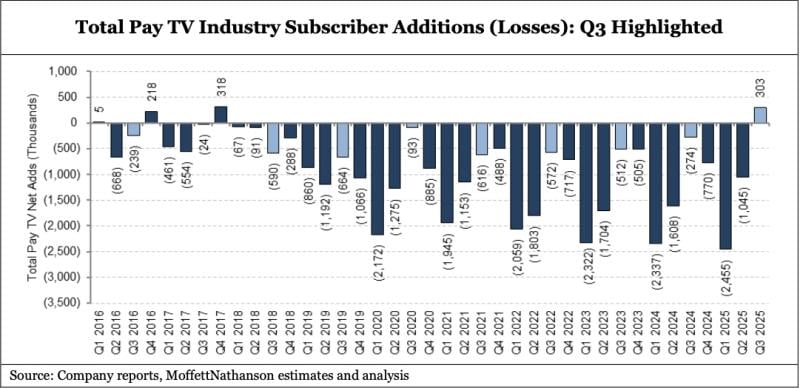
An anonymous reader quotes a report from Ars Technica: On Monday, research analyst MoffettNathanson released its "Cord-Cutting Monitor Q3 2025: Signs of Life?" report. It found that the pay TV operators, including cable companies, satellite companies, and virtual multichannel video programming distributors (vMVPDs) like YouTube TV and Fubo, added 303,000 net subscribers in Q3 2025. According to the report, "There are more linear video subscribers now than there were three months ago. That's the first time we've been able to say that since 2017."

In Q3 2017, MoffettNathanson reported that pay TV gained 318,000 net new subscribers. But since then, the industry's subscriber count has been declining, with 1,045,000 customers in Q2 2025, as depicted in the graph [here]. The world's largest vMVPD by subscriber count, YouTube TV, claimed 8 million subscribers in February 2024; some analysts estimate that number is now at 9.4 million. In its report, MoffettNathanson estimated that YouTube TV added 750,000 subscribers in Q3 2025, compared to 1 million in Q3 2024.

Traditional pay TV companies also contributed to the industry's unexpected growth by bundling its services with streaming subscriptions. Charter Communications offers bundles with nine streaming services, including Disney+, Hulu, and HBO Max. In Q3 2024, it saw net attrition of 294,000 customers, compared to about 70,000 in Q3 2025. Other cable companies have made similar moves. Comcast, for example, launched a streaming bundle with Netflix, Peacock, and Apple TV in May 2024. For Q3 2025, Comcast reported its best pay TV subscriber count in almost five years, which was a net loss of 257,000 customers.
"Traditional pay TV -- i.e. cable and satellite -- still declined quarter over quarter in Q3, but again, by less," noted SteamTV Insider. "The [year-over-year] rate of attrition dropped from -12.4 percent to -10.2 percent over 12 months."

MoffettNathanson added: "Yes, Q3 saw a positive net add number for [pay TV for] the first time in eight years, but that positive result came in the year's seasonally strongest quarter. We're not yet close to seeing the category actually grow again..."

Slashdot Top Deals