Medicine

Robotic Prostheses For Human Faces 111

holy_calamity writes "New Scientist reports on a patent application that suggests implanting polymer muscles beneath the skin of people suffering paralysis of the face to give them control of their features. The technique has already been used successfully to reanimate the eyelids of human cadavers. Movement could be returned to other facial features and even paralyzed limbs in the same way, the surgeons at University of California Davis say. The full patent application is also available on the WIPO site."
Cellphones

EU Commissioner Wants Standard For Mobile Phone Connectors 374

Jantastic writes "European Commissioner Günter Verheugen wants manufacturers of mobile phones to come up with a standard connector for chargers and microphones. If companies fail to do so, proposed legislation should speed up this process. In theory, this could improve competition, while enabling longer life cycles for these devices."
Hardware

A Brief History of Chip Hype and Flops 275

On CNet.com, Brooke Crowthers has a review of some flops in the chip-making world — from IBM, Intel, and AMD — and the hype that surrounded them, which is arguably as interesting as the chips' failures. "First, I have to revisit Intel's Itanium. Simply because it's still around and still missing production target dates. The hype: 'This design philosophy will one day replace RISC and CISC. It is a gateway into the 64-bit future.' ... The reality: Yes, Itanium is still warm, still breathing in the rarefied very-high-end server market — where it does have a limited role. But... it certainly hasn't remade the computer industry."
Hardware Hacking

Reverse Engineering a Missile Launcher Toy's Interface 118

nitro writes "A fairly in-depth technical report by the security researchers at TippingPoint was released on how to reverse engineer the proprietary protocol for controlling a USB missile-launching toy system. They develop an iPhone application to control the device. 'The hardware is coupled with a simple GUI controller written in Delphi (MissileLauncher.exe) and a USB Human Interface Device (HID) interface written in C++ (USBHID.dll). The toys lost their allure within minutes of harassing my team with a barrage of soft missile shots. That same night I thought I would be able to extend the fun factor by coding up a programmatic interface to the launchers in Python. ... One interesting thing is that we have a lot more granular control of the turret movement now than we did with the original GUI. I wrote two simple loops to count the number of possible horizontal and vertical ticks and the results were 947 horizontal and 91 vertical versus 54 and 10 from the original GUI respectively. Granular control allows you to slowly and quietly reposition the turret for stealthy attacks.'"
Data Storage

Long-Term Performance Analysis of Intel SSDs 95

Vigile writes "When the Intel X25-M series of solid state drives hit the market last year, there was little debate that they were easily the best performing MLC (multi-level cell) offerings to date. The one area in which they blew away the competition was with write speeds — initial reviews showed consistent 80MB/s results. However, a new article over at PC Perspective that looks at Intel X25-M performance over a period of time shows that write speeds are dramatically reduced from everyday usage patterns. Average write speeds are shown to drop to half (40MB/s) or less in the worst cases, though the author does describe ways that users can recover some of the original drive speed using standard HDD testing tools." Reader MojoKid contributes related SSD news that researchers from the University of Tokyo have developed a new power supply system which will significantly reduce power consumption for NAND Flash memory.
Handhelds

Palm Pulls the Plug On Palm OS 300

BobB-nw writes to tell us that Palm has decided to kill their PalmOS operating system and is instead betting their future on a still mostly unknown Palm webOS. Very little is known about the new Palm webOS, but it will supposedly support HTML5 and enable a local data store so that applications can be used both online and off. All of this is rolled into a Linux framework with a message bus based on JSON. Will be interesting to see where they take it.
Transportation

MIT Team Creates Shock That Recharges Your Car 281

An anonymous reader writes "If you had a GenShock, you may not mind those potholes in the road any longer because this new prototype shock actually harvests energy from bumps in the road to save on fuel. A team of students at MIT have invented a shock absorber that harnesses energy from small bumps in the road, generating electricity while it smooths the ride more effectively than conventional shocks. Senior Shakeel Avadhany and his teammates say they can produce up to a 10 percent improvement in overall vehicle fuel efficiency by using the regenerative shock absorbers. They also already have a lot of interest in their design, specifically the company that builds Humvees for the army are already planning to install them in its next version of the Humvee."
Data Storage

The Hairy State of Linux Filesystems 187

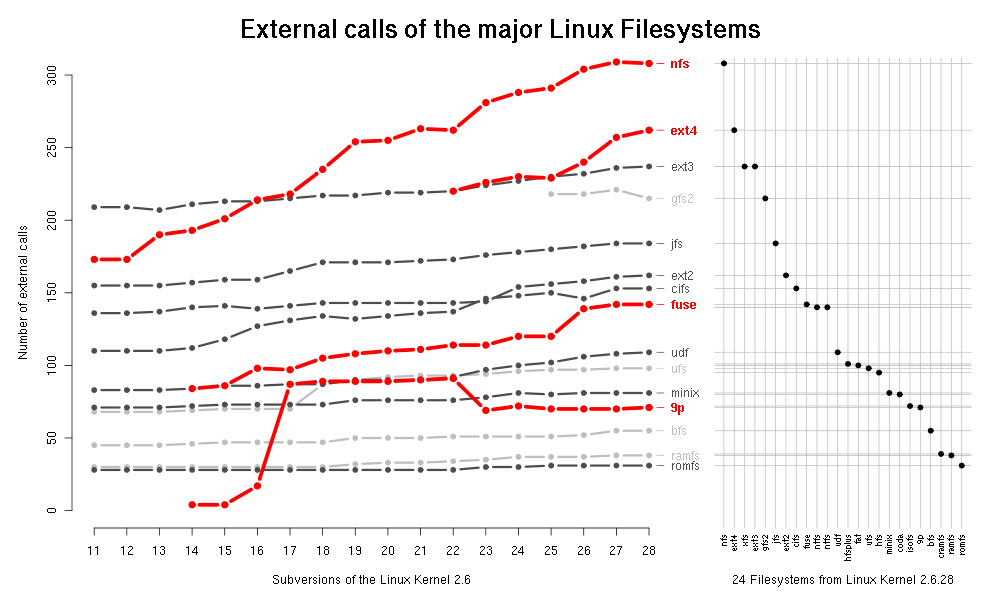
RazvanM writes "Do the OSes really shrink? Perhaps the user space (MySQL, CUPS) is getting slimmer, but how about the internals? Using as a metric the number of external calls between the filesystem modules and the rest of the Linux kernel I argue that this is not the case. The evidence is a graph that shows the evolution of 15 filesystems from 2.6.11 to 2.6.28 along with the current state (2.6.28) for 24 filesystems. Some filesystems that stand out are: nfs for leading in both number of calls and speed of growth; ext4 and fuse for their above-average speed of growth and 9p for its roller coaster path."
Power

Scientists Harvest Nano-Power From Hamsters 90

Al writes "Researchers at Georgia Tech have come up with the ideal way to test a new peizo-electric device that efficiently harvests power from bio-movement — attaching it to a hamster. The device contains a series of zinc-oxide nanowires mounted on top of a flexible plastic surface. As the plastic bends, the wires generate around a nanowatt of power. The Georgia Tech team, led by Zhong Lin Wang, wanted to show that their device could produce power from irregular movements so they attached it to a tiny hamster jacket. They also tried attaching it to a volunteer's finger. Here's a video of the hamster wearing his piezo-power outfit."
The Internet

UPS, Generators Join Servers For Boxed Data Centers 63

miller60 writes "As more companies look into using a 'data center in a box,' you can now get your UPS and generator in a box as well. HP and Sun have begun offering containerized power and cooling infrastructure along with their data center containers, offering an expansion path for facility owners that have run out of power and cooling capacity. Microsoft also plans to use containerized power and cooling in its next-generation facilities, allowing it to build them with no roofs (remember its tent data centers?)."
Hardware Hacking

Build a BoxeeBox and Wean Yourself From Cable 335

Since I've been having serious problems with satellite all week, DeviceGuru's submission was really interesting to me. He says "Inspired by Roku's awesome Netflix video download box and impressed with Boxee's free A/V media center platform, it was merely a matter of time before DeviceGuru blogger Rick Lehrbaum would create the BoxeeBox, an Ubuntu-powered HTPC with Boxee serving as its primary media center UI. Based on a 2.5GHz Core 2 Duo CPU, the BoxeeBox has the look and feel of consumer A/V equipment and packs 2GB RAM, 1TB HDD, CD/DVD drive, USB, Firewire, HDMI, DVI-D, RGB, and 8-channel surround sound audio."
Intel

Intel Moves Up 32nm Production, Cuts 45nm 193

Vigile writes "Intel recently announced that it was moving up the production of 32nm processors in place of many 45nm CPUs that have been on the company's roadmap for some time. Though spun as good news (and sure to be tough on AMD), the fact is that the current economy is forcing Intel's hand as they are unwilling to invest much more in 45nm technologies that will surely be outdated by the time the market cycles back up and consumers and businesses start buying PCs again. By focusing on 32nm products, like Westmere, the first CPU with integrated graphics, Intel is basically putting a $7 billion bet on a turnaround in the economy for 2010."
Intel

VIA Nano Bests Intel Atom In Netbook Benchmarks 130

Glib Piglet writes "ZDNet UK has a whole set of benchmarks comparing a 1.8 GHz Nano in VIA's Epia SN motherboard and a 1.6 GHz Atom in Intel's 'Little Falls' D945GCFL mobo. It's not good news for Chipzilla: 'As far as memory performance is concerned, the Nano is clearly superior in every test' and 'The VIA Nano emerges as the better processor for internet tasks. While the Atom needs 132.8 seconds to display simple HTML pages, the Nano does it in 70.1 seconds.' The Nano even outperforms Nehalem on one test. It's not all a win for VIA, though. The benchmark concludes that in some ways all netbooks, underpowered as they are, remain in the IT stone ages."
Transportation

Two Big Tests For Personal Rapid Transportation 299

Al writes "A novel kind of transit system, in which cars are replaced by a network of automated electric vehicles, is about to get its first large-scale testing and deployment. Two of these Personal Rapid Transit (PRT) systems are being installed this year, one at Heathrow International Airport, near London, and one in the United Arab Emirates, where it will be the primary source of transportation in Masdar City, a development that will eventually accommodate 50,000 people and 1,500 businesses and is designed to emit no carbon dioxide. The article examines these two systems and includes video that includes an animation of the PRT system in action."
Portables

Shifting Apps To ARM Chips Could Save Laptop Batteries 326

An anonymous reader writes "When is an Intel PC not an Intel PC? When it moves applications such as Internet browsing and email on to an ARM processor because it can get longer battery life. And according to a story at EE Times, this hybrid Intel-ARM processor approach is being taken by PC makers as prominent as Dell. The problem for Intel: Why would you switch out of 'all-day' mode and use the Intel processor? The problem for ARM: lacking support from Microsoft for Windows; the applications it runs for the PC have to do so under Linux."
Hardware Hacking

Stop-Motion Modbook Upgrade Video 14

Brian Northway writes "This funny, stop-motion, photo-animated video shows the process of converting an Apple MacBook to an Axiotron Modbook tablet, in one minute and fifty-nine seconds — viewable in standard quality or high-definition (720p), for exceptional detail. It's the latest installment a series of light-speed technical videos that I've created, wihich include the explorational disassembly of a PSP-3000, a unibody MacBook Pro, a MacBook Air, an iPhone, and many other Apple devices."
Hardware Hacking

Hackable Microcontroller-Powered Valentine's Card 133

compumike writes "If you have a significant other to impress this Valentine's Day, consider putting your programming skills to use. This video tutorial shows how to build an LED Heart Valentine's card, powered by a microcontroller running C code, with a neat randomized 'twinkling' effect in an interrupt handler. Think about it: how many ladies can say that their Valentine's card runs at 14 MHz?"
AMD

AMD Launches New Processor Socket Despite Poor Economy 215

arcticstoat writes to tell us that despite a poor economic climate, AMD is moving forward with a new processor socket launch, although they are trying to make it as upgrade-friendly as possible. "As you probably already know from the AM3 motherboards that have already been announced, AM3 is AMD's first foray into DDR3 memory support. As Phenom CPUs have integrated memory controllers, it's more accurate to say that it's the new range of Phenom II CPUs (see below) that are DDR3-compatible. However, the new DDR3-compatible Phenom II range is also compatible with DDR2 memory. As the new CPUs and the new AM3 socket are pin-compatible with the current AM2+ socket, you can put a new AM3-compatible CPU into an existing AM2+ motherboard. This means that you can upgrade your CPU now without needing to change your motherboard or buy pricey new DDR3 memory."

Slashdot Top Deals