Power

Bill Gates's New Version of the Einstein Letter 407

dcblogs writes "In 1939, Albert Einstein sent 'F.D. Roosevelt, President of the United States,' a letter with a warning about Germany's interest in a new type of energy with potential for use as a powerful bomb. The letter also outlined the competitive threat posed by Germany and steps for improving US research efforts. Last week, Bill Gates, along with GE's CEO and others, met with President Obama to deliver their own message: that of the top 30 companies in the world working on alternative energy, only four are in the US. Similar to Einstein's point and recommendations, Gates and his allies are asking the US to view the alternative energy push as a competitive threat posed by other nations, particularly China, which may be doing a better job in bringing its engineering talent and money to bear on this problem."
Hardware

SeaMicro Unveils 512 Atom-Based Server 183

1sockchuck writes "Stealthy startup SeaMicro has unveiled its new low-power server, which incorporates 512 Intel Atom CPUs, a load balancer and interconnection fabric into a 10u server. SeaMicro, which received a $9.3 million government grant from DOE to develop its technology, says its server uses less than 2 kilowatts of energy — suggesting that a single rack with four SeaMicro units and 2,048 CPUs could draw just 8 kilowatts of power. Check out the technical overview, plus additional coverage from Wired, GigaOm and VentureBeat."
Power

Hong Kong Company Develops Solar-Powered Lightbulb 222

hussain_mkj writes "A Hong Kong-based company, Nokero, has introduced what it claims is the world's first solar powered lightbulb. Nokero is trying to replace traditional kerosene lamps in developing countries with its solar-powered N100 LED lightbulbs. The bulb is about the same size as normal incandescent bulbs, and will shine for two hours when charged for a day. The company claims that the new bulb is five times as bright as a kerosene lamp and uses 1/200th the energy. It will cost $15 for one and $480 for 48."
Power

Can Transistors Be Made To Work When They're Off? 89

An anonymous reader writes "Engineers at the Belgian research institute IMEC are looking at the use of silicon transistors in the sub-threshold region of their operation as a way of pursuing ultra-low power goals. A chip the engineers are designing for biomedical applications could have blocks designed to operate at 0.2 or 0.3 volts, researchers said, according to EE Times. The threshold voltage is the point at which the transistor nominally switches off. Operating a transistor when it is 'off' would make use of the leakage conduction that is normally seen as wasted energy, according to the article."
Microsoft

Microsoft's Sleep Proxy Lowers PC Energy Use 163

alphadogg writes "Microsoft researchers have slashed desktop energy use with a sleep proxy system that maintains a PC's network presence even when it is turned off or put into standby mode. Microsoft has deployed the sleep proxy system to more than 50 active users in the Building 99 research facility in Redmond, Wash., according to the Microsoft Research Web site and a paper that will be presented at the Usenix technical conference in Boston later this month. ... Sleep proxies allow machines to be turned off while keeping them connected to the network, waking the machines when a user or IT administrator attempts to access them remotely."
Businesses

Foxconn May Close Factories In China 476

ChiefMonkeyGrinder writes "Foxconn, the manufacturer whose clients include Apple, Dell, and HP, is on the verge of pulling out of China after a spate of suicides. The CEO has accused workers of killing themselves for financial compensation, and the company has stopped suicide payments to suicide victims' families. Foxconn's CEO also told investors that it is considering moving its production operations to Taiwan, and automating many parts of its business, a move which could see 800,000 workers lose their jobs."
Canada

Bionic-Eyed Man Wants To Stream Eye Video Online 115

An anonymous reader writes "According to this IEEE article, Canadian filmmaker Rob Spence, who calls himself Eyeborg because he replaced his false right eye with a bionic one, is showing off his latest prototype. The new bionic eye contains a battery-powered, wireless video camera that can transmit a low-res feed to a nearby receiver. Now Spence plans to share his 'vision' online, literally. According to the IEEE article, 'soon people will be able to log on to his video feed and view the world through his right eye.'"
Power

Renewable Energy To Power Aussie SKA 48

schliz writes "New solar and geothermal energy facilities are being built in Australia to provide sustainable energy for the region's Square Kilometer Array (SKA) bid. The Australian Government yesterday announced A$47.3m in funding for a full-scale, hybrid solar and diesel plant for the Australian SKA Pathfinder (ASKAP) at the Murchison Radio-astronomy Observatory, and geothermal energy facilities for the Pawsey High-Performance Computing Centre, where data from SKA radio telescopes would be processed. ASKAP is part of the Australasian bid to host the $2.5 billion Square Kilometre Array (SKA), which involves 20 countries and will investigate galaxy evolution, dark matter, and the existence of life. IBM expects the whole of the SKA to produce an exabyte of data per day."
Earth

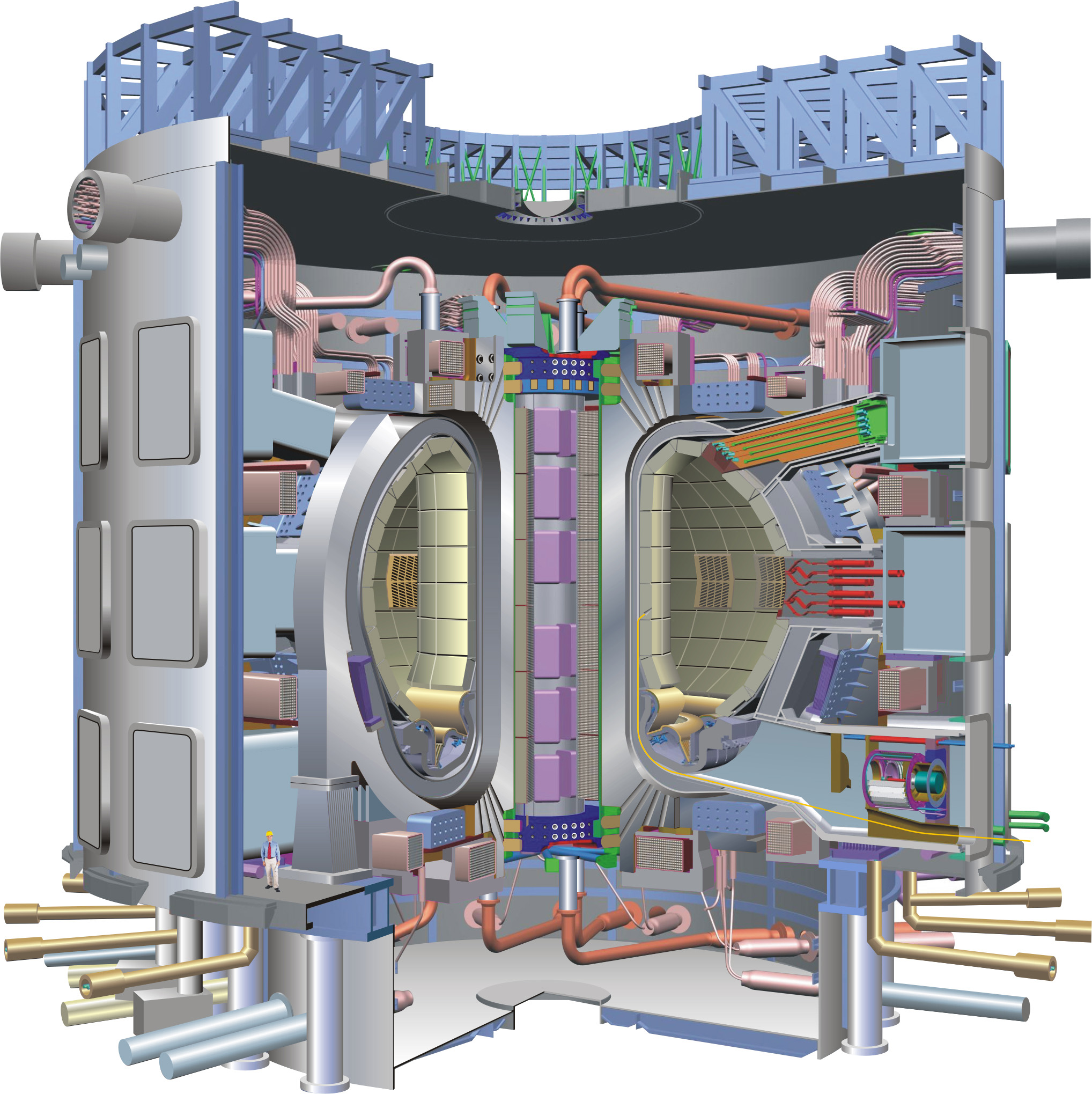
ITER Fusion Reactor Enters Existential Crisis 470

deglr6328 writes "The long beleaguered experimental magnetic confinement fusion reactor ITER is currently in what some are calling the worst crisis of its 25 year history. Still existing only on the paper of thousands of proposed design documents, the latest cost estimates for the superconducting behemoth are soaring to nearly 20 billion USD — roughly twice the estimates from as recently as a few years ago. Anti-nuclear environmentalist organizations have seized upon the moment as an opportunity to use the current global economic crisis as a means to push for permanently killing the project. If ITER is not built, the prospect of magnetic confinement fusion as a technique to reach thermonuclear breakeven and ignition in the laboratory would be in serious question. Meanwhile, the largest laser-driven inertial confinement fusion project, the National Ignition Facility, has demonstrated the ability to use self-generated plasma optical gratings to control capsule implosion symmetry with high finesse, and is on schedule to achieve ignition and potentially high gain before the end of the year."
Image

Solar-Powered Shrub Car Screenshot-sm 47

sparksfly writes "The Terrestrial Shrub Rover is a solar-powered vehicle that looks, as you may have guessed, exactly like a large shrub. According to designer Justin Shull, 'In the spirit of NASA and its forthcoming 2020 lunar expeditions in preparation for colonizing the moon, the Terrestrial Shrub Rover presents the opportunity to explore terrestrial and social environments back on Earth from within a manned, foliage bedecked, solar electric powered rover.'
Input Devices

German Researchers Show Off a Gesture-Based Interface 69

smitty777 writes "The folks at the Potsdam University have developed a user interface based completely on hand gestures. A small(ish) device worn around the neck is used to track the hand position, allowing the user to draw, type, or gesture in the air. You think it looks ridiculous when you can't tell that folks are talking on a cell phone? Imagine a bus full of people gesturing in thin air. Also, don't forget to turn this thing off, or it will look like your cat was walking on your keyboard." Update: 06/11 00:54 GMT by T : This informative comment (kudos!) adds links to a video demonstration and the researcher's own site.
Music

Rock Band 3 To Include MIDI Keyboard 107

xbeefsupreme writes with news that Harmonix has officially demonstrated Rock Band 3's 25-key MIDI keyboard. From USA Today: "During the game, green, red, blue, yellow or orange keys flow on a 'stream' representing the notes to be played on five corresponding keyboard keys. In a new authentic Pro mode meant to help players segue to actual instruments, all 25 keys are used; the streams shifts left and right to cover the correct keys. The keyboard also works as a MIDI keyboard that can be connected to a computer. 'This is a real instrument and a real device,' says senior designer Sylvain Dubrofsky." The game will also support more advanced "real" guitar controllers, which have six actual strings you can strum. Hit the link below to see the keyboard in use.
Displays

For Normals, Jobs' "Retina Display" Claim May Be Fair After All 386

The Bad Astronomer writes "AT WWDC, Steve Jobs claimed that the iPhone 4's display has about the same resolution as the human eye — held at one foot away, the iPhone 4's pixels are too small to see. After reading an earlier Slashdot post about an expert disputing Jobs' claim, I decided to run the numbers myself. I found that Jobs is correct for people with normal vision, and the expert was using numbers for theoretically perfect vision. So to most people, the iPhone 4 display will look unpixellated."
Hardware

MINI-ITX and the Future of PC Case Design? 164

An anonymous reader writes "One of the interesting things to come out of the recent Computex electronics show in Taiwan was striking new PC cases — in particular systems built around tiny Mini-ITX boards. What may have once been regarded as the weird little brother of the more common Micro-ATX, the popularity of PCs built with these boards seems to be gradually building. This year at Computex saw the first Mini-ITX boards to support USB 3.0 and SATA 6Gbps, and a variety of new shapes and styles in both Micro-ATX and Mini-ITX case design. This photo gallery shows some of the more striking examples of these new PC cases from Computex, including one that appears to be modelled on an Xbox 360, and one with a VESA mount for strapping to the back of a monitor. Interestingly, while these designs have usually been associated with home theatre system PCs, or for saving space on office desktops, there is also now a trend towards pushing 'gamer' features like windows and multiple fans into these small form factor cases."
Power

Solar Cell Inventor Wins Millennium Prize 147

adeelarshad82 writes "The inventor of a new type of solar cell won the Finnish state and industry-funded, €800,000 ($1.07 million), Millennium Technology Prize. According to the foundation, Michael Graetzel's dye-sensitized solar cells, known as Graetzel cells, could be a significant contributor to the future energy technologies due to their excellent price-performance ratio."
Operating Systems

Canonical Developing Ubuntu OS For Tablets 228

snydeq writes "Canonical is preparing a version of the Ubuntu OS for tablet computers as the company looks to extend its presence in the mobile space, InfoWorld reports. The OS will be a lightweight version of Linux with a simplified, touch-friendly user interface, and tablets with the Ubuntu OS could become available late in winter 2011. The focus will be on developing an OS with a simplified user interface that provides quick access to the most-used applications. Development efforts will also focus on adding on-screen keyboard features and compatibility for multitouch drivers."
Cellphones

iPhone 4's "Retina Display" Claims Challenged 476

adeelarshad82 writes "Of the many things that buyers might need to know about the new iPhone, Raymond Soneira — president of DisplayMate Technolgies — added one more to the list. Soneira challenged Apple's claims that Apple's new iPhone contains a so-called 'retina display.' According to Soneira, the resolution of the retina is in angular measure, 50 cycles per degree, where a cycle is a line pair, which is two pixels, so the angular resolution of the eye is 0.6 arc minutes per pixel. So, if you hold an iPhone at the typical 12 inches from your eyes, that works out to 477 pixels per inch. At 8 inches it's 716 ppi. You have to hold iPhone 4 out about 18 inches before it falls to 318 ppi. So the iPhone has significantly lower resolution than the retina."
Security

Olympus Digital Camera Ships With a Worm 249

An anonymous reader writes "Olympus Japan has issued a warning to customers who have bought its Stylus Tough 6010 digital compact camera that it comes with an unexpected extra — a virus on its internal memory card. The Autorun worm cannot infect the camera itself, but if it is plugged into a Windows computer's USB port, it can copy itself onto the PC, then subsequently infect any attached USB device. Olympus says it 'humbly apologizes' for the incident, which is believed to have affected some 1,700 units. The company said it will make every effort to improve its quality control procedures in future. Security company Sophos says that more companies need to wake up to the need for better quality control to ensure that they don't ship virus-infected gadgets. At the same time, consumers should learn to always ensure Autorun is disabled, and scan any device for malware before they use it on their computer."
Earth

2 In 3 Misunderstand Gas Mileage; Here's Why 1042

thecarchik sends in this piece, which was published last March but remains timely: "OK, so here's a little test: Which saves more gasoline, going from 10 to 20 mpg, or going from 33 to 50 mpg? If you're like most Americans, you picked the second one. But, in fact, that's exactly backwards. Over any given mileage, replacing a 10-mpg vehicle with one that gets 20 mpg saves five times the gasoline that replacing a 33-mpg vehicle with one that gets 50 does. Last summer, Duke University's Fuqua School of Business released a study that shows how much damage comes from using MPG instead of consumption to measure how green a car is. Management professors Richard Larick and Jack Soll's experiments proved that consumers thought fuel consumption was cut at an even rate as mileage increased."

Slashdot Top Deals