Spam

IronPort Arms Both Sides In Spam War 216

securitas writes "We all know about IronPort's recent acquisition of SpamCop. What may not be common knowledge is that IronPort's Senderbase has 'the reputation as the fastest way to send millions of junk e-mail messages' and is popular with spam factories. Founded by two former Microsoft executives - Hotmail's Scott Weiss and ListBot founder Scott Banister - IronPort claims its customers are not spammers but legitimate marketers. Critics say that this is a clear conflict of interest. Playing spam from both sides might be likened to a pharmaceutical company enabling the spread of a disease in order to sell the cure. SpamCop founder Julian Haight - who had to sell the company in order to remain solvent - is quoted as saying of IronPort's anti-spam measures: "I am not sure all its standards are tough enough." The story was originally reported by the New York Times' Saul Hansell. Abbreviated mirror at IHT."
Wireless Networking

What Has Number Portability Done For You? 756

Coldeagle writes "Number portability has been around for a few days now, I was wondering; have any of you fellow Slashdot readers switched carriers? How was your experience, and have you seen any price warring since it went into place?" Or is number portability so far more hype than happenin'?
GUI

Window Managers For Small Screens? 94

saintlupus writes "I've got a question for the rest of the Slashdot community. I'm using an old clamshell iBook at work with Debian/PPC on it. As any Apple site can tell you, the iBooks of that era had a maximum resolution of 800x600. Now, I use a 19" monitor and a 17" monitor running together with Xinerama on my machine at home, and I'm used to that much space. I use WindowMaker on that computer, but on an 800x600 screen those Dock icons look the size of buses. Can anyone recommend a window manager that uses a minimum of screen real estate so that I can fit a bit more on the iBook's LCD?"
Linux Business

DoCoMo To Use Linux On Their 3G phones 139

ilbrec writes "Looks like NTT DoCoMo will be using Linux on their 3G phones next year. This actually was reported yesterday in Japan (here), but I could not find any article in English until now. While it's not clear who will be making the Linux phone for them, I would certainly be interested in seeing them once they are out. No word on this anywhere at DoCoMo's website at all, however." Reader paku adds links to similar coverage in Forbes and in Japan Today.
Toys

Robotics + Car = Hallucigenia 165

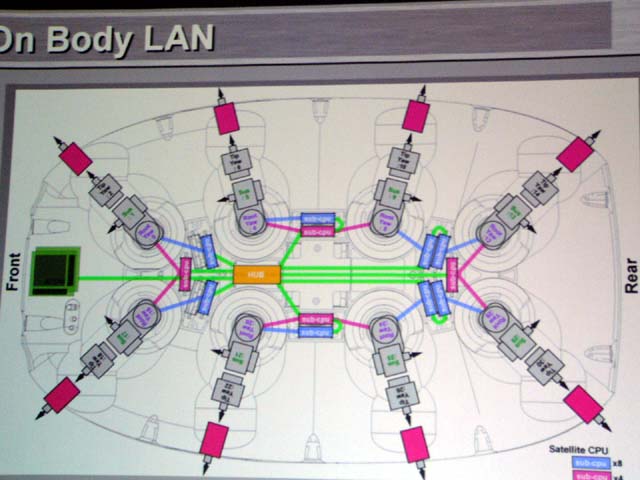
News for nerds writes "I4U has news about a new transportation concept, called The Hallucigenia 01, which is a working 1/5 scale vehicle prototype, designed by Japanese design firm Leading Edge Design. PC Watch (Japanese) has photos and movies. Its 8 wheels are independent robotic arms controlled by their own satellite CPUs, interconnected to the main CPU by an internal LAN."
PlayStation (Games)

Sony's PSX Game/Media Hub Loses Features For Early Release 49

StingRay02 writes "Sony's recently announced 'digital media hub', the PlayStation 2-based PSX, is getting a feature downgrade to facilitate getting it out of the door for the holidays in Japan, according to a GameSpot article. Apparently, the following features are being cut: HDD to DVD dubbing has been downgraded from 24x speed to 12x speed, CD-R playback will not be supported, DVD+RW playback will not be supported, MP3 file format will not be supported, TIFF and GIF file formats will not be supported, Sony's Cybershot movie format will not be supported. There will also be no antenna output, nor will it be compatible with the Playstation BB service. The original specs can be found on Sony's website." The company "plans to offer firmware updates to owners", but it's unclear as yet what features this will add.
Television

A Hackable Media Player For HDTV 216

An anonymous reader writes "Embedded Linux and an open, hacker-friendly architecture power the world's first high definition media player, the $499 Roku HD1000. The brainchild of ReplayTV inventor Anthony Wood, the device could touch off a cottage industry of third-party applications and media packs that work with its Linux-based OS and user-friendly media APIs. Out of the box, the HD1000 can stream MPEG and MPEG2, play music, loop JPEGs, and more to an HDTV -- all at the same time. Roku is selling "Art Packs" of everything from museum-quality art to hot-rod cars as memory cards that work with the device. And, the company will release a C/C++ SDK for the HD1000 before 2004. Finally, there's something to actually show on your $5,000 54-inch plasma TV or 37-inch LCD TV." (Roku is also one of the companies mentioned in an earlier posting about using hi-def displays as digital art galleries).
Television

Japan's TV Broadcasts To Be All-Digital By 2011 241

Azuma writes "Officially, Japan will end Analog broadcasting by year 2011. Terrestrial digital television broadcasting services started on Monday, December 1st in Tokyo, Nagoya and Osaka, with Japan Broadcasting Corp (NHK) and private TV stations broadcasting special commemorative programs. The services will initially be available to around 12 million households. Here is an article from Chinaview. The Daily Yomiuri reports that small local TV stations are at a disadvantage due to high costs of the new technology."
Education

What's Out There for Handheld Math? 92

PowerVegetable asks: "What's the story with handheld computation? Not address books and schedule reminders; I'm talking about the type of stuff computers were invented for. Anyone who's used Mathematica or Maple knows what desktop computers are capable of these days math-wise, but handheld computation seems to have fallen behind on the innovation front. Cell phones and handheld game systems have certainly enjoyed rapid advancement, so where are the handheld mathematical portable oracles? What's available that doesn't have obscure menu systems, bad displays, underpowered processors and unwieldy programming languages? Pickings are slim in the hard-coded calculator industry, but what about Pocket PC's or other programmable portables? Is there any portable solution out there that's more capable than my old HP49g?"
Censorship

Who Owns The Facts? 490

windowpain writes "With all of the furor over the Patriot Act a truly scary bill that expands the rights of corporations at the expense of individuals was quietly introduced into congress in October. In Feist v. Rural Tel. Serv. Co. the Supreme Court ruled that a mere collection of facts can't be copyrighted. But H.R. 3261, the Database and Collections of Information Misappropriation Act neatly sidesteps the copyright question and allows treble damages to be levied against anyone who uses information that's in a database that a corporation asserts it owns. This is an issue that crosses the political spectrum. Left-leaning organizations like the American Library Association oppose the bill and so do arch-conservatives like Phyllis Schlafly, who wrote an impassioned column exposing the bill for what it is the week after it was introduced."
Data Storage

Recovering Deleted Files on ReiserFS3? 126

DarkSarin asks: "I have a rather serious problem: I managed to accidentally delete some files (rather important ones at that!) while trying to back them up to cd (I was using a GUI burning software that will remain nameless for now). How do you recover accidentally deleted files in Reiserfs? This thread (started by me) indicates that you can't recover them. Note that I had found a way to rebuild the tree, but that didn't work. It seems odd to me that you wouldn't be able to recover accidental deletions, but that really does seem to be the case. Help? Please?"
Linux Business

Cheap Linux Tablets, And (Maybe) An Apple Tablet 351

penguinrenegade writes "Element Computer has come out with the first sub-$1000 Tablet, and it doesn't come with Windows. It's not running a stripped OS like Windows CE, but a full-fledged copy of Lycoris Desktop/LX. This company seems to really have it in for Microsoft, with a 'No Windows' policy. Good to see someone finally standing up against paying the Microsoft tax. Maybe now we'll start seeing Linux only OEMs and resellers." Also on the tablet computer front, SeanAhern points out Cringely's latest Robert X. Cringely column, in which Cringley makes the case that Apple is readying a tablet computer for market, and "suggests that 'until next year, the parts won't have been there to make tablet PCs successful. What's missing has been the killer app, and what kept a killer app from appearing was a lack of hardware support, which I believe will be over soon,'" writing "He's got some interesting ideas about where Jobs might go with his Digital Hub idea." (This is an Antaur-based machine, not the Toshiba tablet mentioned in October.)
Displays

Toward Micro-Diode Display Panels? 150

VernonNemitz asks: "Light-Emitting Diodes (LEDs) have been around for decades, and they come in all colors. Here are the basic principles behind their operation, information on what's currently in production , and other practical info. Now, you would think it obvious that video displays should be made from LEDs, to take on the various competitors. Certainly this has been done on a large scale, and I am not the first to be interested in LED display technology for home viewing. The apparent goal of silicon LEDs these days seems to be tied up with optical communications between circuits, have they forgotten the possibility of making high-resolution display panels?"
Intel

Intel Researchers See Moore's Law Becoming Obsolete 396

prostoalex writes "A paper, published by Intel researchers, claims we might be the witnesses of Moore's Law becoming obsolete, as the rate of shrinkage for transistors goes lower with each year. In 2018 we might be able to get the chips manufactured with 16-nanometer technology, then one or two more manufacturing processes will shrink it even further, but after that we're facing the physical limits."
Data Storage

Simple Document Imaging for Unix? 47

andylievertz asks: "I have developed a logical system of directories for storing my digital documents (i.e. *.doc, *.mp3, *.gif, etc.), and can usually find any obscure document with relative speed. These 'must-keep' hardcopies include everything from bills and shipping invoices to brochures and chinese-food menus. I've tried applying my electronic filing techniques to an actual, real-world filing cabinet, complete with folders and labels, but such a system: requires a great deal of effort to maintain relative to the electronic system, especially considering the frequent influx of new hardcopy material; and doesn't address the greater issue of reducing the sheer paper bulk, organized or not. What solutions have you, the Slashdot Reader, employed to solve this situation for yourself? Are there viable Unix-based Document Imaging packages, similar in function to the Microsoft Document Imaging utility packaged with Office? Do you use a Unix-based Document Imaging solution personally or professionally? If so, what package, and why does it work for you?"
Businesses

Where Are The Founders Of The Dial-Up Revolution? 295

RIMBoy writes "The Atlanta Journal-Constitution recently tracked down the founders behind the dial-up modem revolution. The founders of Hayes Micromodem set the standard with their AT Command set. While Dennis Hayes finds himself inducted into the Computer Industry Hall of Fame, at the same time he is broke (with a stop as a bar owner) and trying to find the next big thing. Dale Heatherington cashed out early and has dedicated himself to several projects, including ham radio."
Wireless Networking

The Future Of Wireless Sensor Networks 122

Frisky070802 writes "In the 12/03 Wired, Intel's Tiny Hope for the Future describes a fundamental transformation as Intel's Research director David Tennenhouse realized the importance of sensor networks. He saw a Berkeley project on 'motes,' little sensors that communicate on ad-hoc wireless networks. 'The company now foresees networks consisting of thousands of motes, located wherever there's a need for data collection, streaming real-time data to one another and to central servers. Intel imagines the day when every assembly line, soybean field, and nursing home on the planet will be peppered with motes, prodding factory foremen to replace faulty machines, farmers to water fields, and nurses to check on something unusual in room E214.' Intel was impressed enough with the technology to fund a whole 'lablet' to develop it. Intel sees a huge potential market in developing both the sensors and the computation to process the huge amounts of sensor information. If this rings any bells, note that the Intel lablets are also behind the Planetlab Internet emulator, previously discussed in Slashdot."
Handhelds

Commodore 64 Emulator For Your Palm Pilot 191

Ridgelift writes "PDALive's got an article on a port of Frodo, the free Commodore 64 Emulator for your Palm Pilot. I can't wait to get this running so I can play M.U.L.E. on the road!" Update: 12/01 02:41 GMT by T : An anonymous reader writes "I thought I should point out that there's also a really great Atari ST emulator for Palm called 'CaSTaway.' You can find it here. It's free and released under GPL :)"
Handhelds

TapWave's Zodiac Handheld Analyzed 26

Thanks to GameSpot for their feature taking a look at TapWave's PDA-based handheld, the Zodiac. They argue: "After using the Zodiac for a bit, you get the impression that it's designed not as a handheld gaming system with some built-in PDA functionality but, rather, as a PDA that also happens to play games pretty well." While being impressed with fan support at sites like Zodiac Gamer, the reviewer suggests: "So far, TapWave has presented a fairly impressive package with the Zodiac, though its current lineup of top-tier games is a little too short to catch the average gamer's attention." The review concludes: "The system is also a little pricey for the gamer on a budget... [but] it's a fairly open platform due to its Palm OS support, so the amateur development community will likely keep the Zodiac stocked with amusement potential regardless of what the system's commercial developers turn out."

Slashdot Top Deals