Databases

Someone Got Doom In an SQL Database (arstechnica.com) 23

An anonymous reader quotes a report from Ars Technica: Rendering Doom in a database is obviously a bad idea," Lukas Vogel writes in a lengthy blog post explaining how exactly he managed to render Doom using an SQL database. OK, that's not entirely accurate. The SQLDoom project uses a small Python client to handle input and output, drive the game's timing, and display each frame to the screen. Behind that, a series of CedarDB tables tracks the game geometry and state, while about 1,300 lines of SQL queries spread across 89 common table expressions implement the game logic and generate 35 bitmap framebuffers per second.

In this, SQLDoom is a major improvement over Vogel's previous DoomQL project, which last year set out to build "a multiplayer Doom-like shooter entirely in SQL." Unfortunately, that effort ended up with raycasting-based, grayscale ASCII graphics that were more akin to the simplistic 90-degree-angled maps of Wolfenstein 3D. The newer SQLDoom, on the other hand, generates full-color 640x480 frames that look like they could have come from the original Doom executable. [...] If you want to run a Doomtabase on your own local machine, you can do so simply with the GitHub code, a copy of CedarDB, and a Doom WAD file. Or you can jump into a free online hosted demo match to test it out without all the setup [...].

Emulation (Games)

PS5 Emulation Is Suddenly Making Big Strides On PC (arstechnica.com) 24

An anonymous reader quotes a report from Ars Technica: For a long time, PC gamers could access many PlayStation 5 games only if the publisher invested in a bespoke port (something Sony has recently said it will be scaling back). Now, though, rapid advancements in PS5 emulators and other tools are making recent PlayStation titles increasingly playable on generic PCs. SharpEmu was the first of these emulators, advancing from a "very early alpha stage" in May to a current state that can "load the eboot.bin of real games, execute native CPU instructions, and partially handle GPU-related functionality." The most recent release boasts 10 tested games that reach a "playable" state, including six that developer CursedIfElse says are "fully playable at 60 fps." That includes simple 2D games like Tetris Forever but also 3D titles like Astro Bot and the PS5 Demon's Souls remaster running at playable frame rates.

[...] Amid that SharpEmu progress, fellow PS5 emulator KytyPS5 launched its first public version last week. The major expansion of PS4-focused emulator Kyty "can boot 2D games and a selection of 3D games, including titles built with Unreal Engine 4/5, Unity, and custom engines," according to its GitHub page. An extensive compatibility list for KytyPS5 already shows 134 titles with "controllable gameplay" on the new emulator, though many of those still include reports of persistent, game-breaking bugs. But you can already find YouTube footage of PS5 titles like Astro's Playroom and Demon's Souls running quite capably under the emulator.

On top of those more traditional emulators, AnyPS5 might be the most interesting effort to get PS5 games running on PC. The self-described "tool for automatic executables porting" works kind of like Apple's Game Porting Toolkit, relinking a PS5 game's original x86 game code directly to native executable instructions that can run on PC. That puts the effort somewhere between direct static decompilation of a game's source code and more complete emulation of the entire PS5 environment.

First Person Shooters (Games)

Male Fruit Fly Brain Trained to Play Doom (pcgamer.com) 51

Last week, Google announced that it managed to produce a detailed 3D reconstruction of an adult male fruit fly's brain and central nervous system. A few days later a software engineer at Coinbase said the fly brain was being trained to play the original Doom. "Each Doom frame stimulates sensory neurons," says Alex Wormuth. "Neural activity is mapped to game controls. Damage triggers a stimulus to two PPL101 dopamine cells as reinforcement." Since then, the digital brain model has been repurposed to control other games like Beat Saber and Super Mario 64. PC Gamer reports: You can even watch the fruit fly play in real time via Wormuth's website, and it not only shows the point of view in Doom, but can also show a third-person render of the fly going around Doom maps. As of the time of writing, the fly is on round 6385 and, well, it's not very good. Sorry, fly.

But modders aren't done here. They have also somehow managed to make the fruit fly play Beat Saber, and play it pretty well. Lyra Bubbles on X has used the brain and replays of a song in Beat Saber to teach the fruit fly where to hit and why, via Reinforcement Learning. That does mean it's not organically reacting to the notes popping up on screen, but it is receiving input and responding to stimuli. Lyra says, "Further training is to reduce reliance on external signals and allow it to play fully reactively with no input data."

And, after "pivoting to fly engineering in 2026", Jessica Paquette also shared on X their experience running the digital fly brain through Super Mario 64. If you think that is all the game's modders made the fruit fly play, think again, as YouTuber Ro0oney even put it in Minecraft. But this time, Ro0oney used Flywire.AI, a similar project made in collaboration with Princeton University. The number of neurons are different (160,000+ vs 139,255), and Google analyzed a male brain whilst Flywire analyzed a female brain, but the basic idea is the same.

First Person Shooters (Games)

James Bond Videogame '007 First Light' Sells 3M Copies, Earns $150M (ign.com) 20

The new James Bond-themed videogame 007 First Light had a budget of 1.3 billion Danish krone — a little more than USD $202 million, reports IGN, citing a report from Denmark's public service broadcaster. "Denmark's TV 2 said that makes 007 First Light the most expensive entertainment product in the country's history" — and the game "still has some way to go before breaking even." 007 First Light is estimated to have sold 2.2 million copies, generating $150 million in revenue... [Saturday IGM reported sales had jumped to 3 million copies.] The only official sales data we have comes from developer IO Interactive, which said that 007 First Light had become the fastest-selling game in the company's history, shifting 1.5 million copies in its first 24 hours... The impressive sales milestone was achieved without the aid of the Nintendo Switch 2 version, which is due out this summer. The James Bond adventure is also the highest rated IOI game ever, with an 87 on Metacritic...

The developer has said it wants to make a trilogy of James Bond games.

Game-tracking company Alinea Analytics tweeted their estimates that 55.1% of sales were on PS5, 33.1% on Steam, and 11.8% on Xbox (Xbox console, Windows, and cloud combined).

And Polygon reports that new downloadable game content was announced Friday.
First Person Shooters (Games)

'Call Of Duty: Warzone' Is Shutting Down On PS4 And Xbox One (kotaku.com) 9

Call Of Duty: Warzone is shutting down on PS4 and Xbox One later this year, reports Kotaku. As Call of Duty fully transitions to PS5 and Xbox Series X/S (and Switch 2), its popular battle royale spin-off, Warzone, is also ditching the old consoles. Later this year, Warzone will no longer be playable on PS4 or Xbox One...

Shortly after Modern Warfare 4 ( MW4) launches on October 23, it will be integrated with Warzone. But because MW4 is skipping PS4 and Xbox One, Activision is starting the process of shutting down Warzone on those older consoles... "Beginning June 4, the game will no longer be available for new downloads on those platforms," [Activision wrote on their blog], "though existing players can continue playing until Season 1 launches. Certain items, such as Call of Duty Points bundle purchases, will no longer be available on those platforms...."

Players who have properly linked their platform accounts to their Activision accounts will be able to keep all their progress and unlocks once they leap to PS5, Xbox Series X/S, or PC. Activision also confirmed on its support site that all past Call of Duty games will remain playable online on PS4 and Xbox One.

The upcoming Call of Duty: Modern Warfare 4 "will be set against a full-scale invasion of South Korea," according to the Washington Post. And they report that Infinity Ward will release the game October 23 "on all modern gaming platforms including, notably, the Nintendo Switch 2. (The blockbuster franchise has long skipped Nintendo consoles.)" The campaign introduces Private Park, a young Korean soldier thrown into combat for the first time, framed as a classic "zero-to-hero story" against the backdrop of global calamity. The franchise's most recognizable hero, Capt. John Price, also returns, this time as a rogue agent, picking up the story of the Modern Warfare timeline that began with 2019's reboot title... [T]he game features a fictional North Korean leader, rather than Kim Jong Un or his family. Infinity Ward said it consulted regional specialists, people who defected from the North and the studio's own Korean employees.

When asked whether the studio is braced for a diplomatic response from Pyongyang (familiar territory for the series), [Jack O'Hara, co-head of Infinity Ward] was dry about it. "We've had state responses to our games before. We'll find out what we all think about each other soon enough," he said...

Infinity Ward is making its most significant mechanical changes in years. The game will remove "bloom," the randomized bullet spread visual trick that game developers use to simulate gunfire chaos, while firing guns from the hip. Instead, bullets will exit the gun in the same direction as the visible recoil on screen, rewarding aim over chance... The studio is also introducing Kill Block, a multiplayer map that reconfigures itself between matches using a modular system of interchangeable sections, producing more than 500 possible layouts.

First Person Shooters (Games)

America's Library of Congress Officially Inducts... the Soundtrack for the Videogame 'Doom' (engadget.com) 19

America's Library of Congress "is preserving a little piece of Hell," jokes Engadget, "by inducting the soundtrack to the original Doom into the National Recording Registry." The album of demon-slaying tracks is joined by several other notable 2026 additions to the registry, like Weezer's self-titled debut album (colloquially known as "The Blue Album"), Taylor Swift's "1989," Beyonce's "Single Ladies (Put a Ring On It) and the original "Mambo No. 5."

"Doom" was created by Bobby Prince, a freelance composer who worked on lots of id Software games, and also scored Doom's '90s rival Duke Nukem 3D. The soundtrack draws clear inspiration from metal bands, but also touches on techno and ambient music throughout its track list, making for an eclectic soundscape for tearing through enemies. That it all fits together is also impressive in its own right: All of the music for Doom was written before the game had completed levels to play through, according to Prince.

The official announcement from the Library of Congress says Doom "brought a heavy metal energy to MS-DOS systems across the globe," while also pioneering first-person shooter videogames. "Key to Doom's popularity was the adrenaline-fueled soundtrack created by freelance video game music composer Bobby Prince. Prince, a lifelong musician and practicing lawyer, was fascinated by the MIDI technology that rose in prominence in the mid-1980s as a means for instrument control and composition... For "Doom," Prince took inspiration from a pile of CDs loaned by the game's chief designer, John Romero, including seminal works by Alice in Chains, Pantera and Metallica.

Despite the limitations of the 1993-era sound card drivers, Prince composed the perfect riff-shredding accompaniment for the game's demon-slaying journey to hell and back. Taking advantage of his knowledge of MIDI, Prince even worked to ensure that the sound effects he created could cut through the music by assigning them to different MIDI frequencies.

Wine

Wine 11 Rewrites How Linux Runs Windows Games At the Kernel Level (xda-developers.com) 55

Linux gamers are seeing massive performance gains with Wine's new NTSYNC support, "which is a feature that has been years in the making and rewrites how Wine handles one of the most performance-sensitive operations in modern gaming," reports XDA Developers. Not every game will see a night-and-day difference, but for the games that do benefit from these changes, "the improvements range from noticeable to absurd." Combined with improvements to Wayland, graphics, and compatibility, as well as a major WoW64 architecture overhaul, the release looks less like an incremental update and more like one of Wine's most important upgrades in years. From the report: The numbers are wild. In developer benchmarks, Dirt 3 went from 110.6 FPS to 860.7 FPS, which is an impressive 678% improvement. Resident Evil 2 jumped from 26 FPS to 77 FPS. Call of Juarez went from 99.8 FPS to 224.1 FPS. Tiny Tina's Wonderlands saw gains from 130 FPS to 360 FPS. As well, Call of Duty: Black Ops I is now actually playable on Linux, too. Those benchmarks compare Wine NTSYNC against upstream vanilla Wine, which means there's no fsync or esync either. Gamers who use fsync are not going to see such a leap in performance in most games.

The games that benefit most from NTSYNC are the ones that were struggling before, such as titles with heavy multi-threaded workloads where the synchronization overhead was a genuine bottleneck. For those games, the difference is night and day. And unlike fsync, NTSYNC is in the mainline kernel, meaning you don't need any custom patches or out-of-tree modules for it work. Any distro shipping kernel 6.14 or later, which at this point includes Fedora 42, Ubuntu 25.04, and more recent releases, will support it. Valve has already added the NTSYNC kernel driver to SteamOS 3.7.20 beta, loading the module by default, and an unofficial Proton fork, Proton GE, already has it enabled. When Valve's official Proton rebases on Wine 11, every Steam Deck owner gets this for free.

All of this is what makes NTSYNC such a big deal, as it's not simply a run-of-the-mill performance patch. Instead, it's something much bigger: this is the first time Wine's synchronization has been correct at the kernel level, implemented in the mainline Linux kernel, and available to everyone without jumping through hoops.

Games

Nvidia GeForce NOW Is Now Available Natively On Linux (phoronix.com) 17

NVIDIA has officially launched a native GeForce NOW client for Linux as a Flatpak, giving Linux gamers access to cloud-rendered RTX gaming. Phoronix reports: While confined to a Flatpak, for now NVIDIA is just "officially" supporting it on Ubuntu 24.04 LTS and later. Granted, thanks to Flatpak it should run on other non-Ubuntu distributions too but in terms of the official support and where they are qualifying their builds they are limiting it just to Ubuntu 24.04 LTS and later. [...] At launch the Flatpak build is also just for x86_64 Linux with no AArch64 Linux builds or similar at this time.

Running GeForce NOW on Linux while games are rendered in NVIDIA's cloud with Blackwell GPUs, you still need to be using a modern GPU with H.264 or H.265 Vulkan Video support NVIDIA isn't yet supporting Vulkan Video AV1 with GeForce NOW on Linux but just H.264/H.265. If you are using NVIDIA graphics the NVIDIA R580 series or newer is recommended while using the X.Org session. If you are using Intel or AMD Radeon graphics, Mesa 24.2+ is recommended and using the Wayland session.

When you are up and running with GeForce NOW on Linux, you have access to over 4,500 games. The free tier of GeForce NOW provides standard access to the gaming servers and limited session caps for an introductory-level experience. It's with the performance tier where you can enjoy RTX ray-tracing and 1440p @ 60 FPS performance and up to six hour sessions. With GeForce NOW's Ultimate tier is where you are running on GeForce RTX 5080 GPU servers with support for up to 5K @ 120 FPS gaming or 1080p @ 360 FPS with up to eight hour gaming sessions in length.

First Person Shooters (Games)

Breach Forces Ubisoft to Take 'Rainbow Six Siege' Offline (engadget.com) 34

Engadget reports on "a widespread breach" of Ubisoft's game Rainbow Six Siege "that left various players with billions of in-game credits, ultra-rare skins of weapons, and banned accounts."

Ubisoft took the game's servers offline early Saturday morning, and as of Sunday night its status page still shows "unplanned outage" on all servers across PC, PlayStation and Xbox: Ubisoft later clarified Saturday afternoon on X that nobody would be banned if they spent their ill-gotten credits, but that a rollback of all transactions starting from Saturday, 6AM ET would soon be underway.
Founded 39 years ago, France-based Ubisoft produces top videogame franchises like Assassin's Creed, with billions in revenue and over 17,097 employees worldwide.
Games

5K Gaming Is Too Hard, Even for an RTX 5090D (pcmag.com) 49

Asus has been showcasing its new 5K 27-inch ROG Strix 27 Pro gaming monitor running at 5,120 x 2,880 resolution and up to 180Hz, but even Nvidia's flagship RTX 5090 struggles to deliver smooth frame rates at this demanding pixel count. In testing conducted by Asus, the RTX 5090D -- a Chinese-exclusive variant with weaker AI performance -- achieved just 51 frames per second in a Cyberpunk 2077 benchmark at ultra ray traced settings. The test system ran an AMD Ryzen 9950X3D processor, had DLSS set to balanced, and kept frame generation disabled. The same configuration running at 4K managed 77 fps, around 50% higher.

The underlying math is simple: 5K resolution requires rendering 78% more pixels than 4K. That 218 PPI pixel density delivers impressive sharpness up close, but Asus chose an IPS panel over OLED technology to reach it, trading away deeper black levels and faster response times. Asus appears to be positioning the monitor as a dual-mode display -- 5K for productivity and video, 1440p at up to 330Hz for gaming. Early Chinese listings have it priced at the equivalent of $800, roughly what you'd pay for a larger 4K OLED panel.
Movies

Why Some Avatar: Fire and Ash Scenes Look So Smooth, and Others Don't (gamesradar.com) 62

If you watched Avatar: Fire and Ash in James Cameron's preferred high frame rate 3D format and noticed certain sequences appearing unusually smooth while others had the traditional cinematic look, that visual inconsistency is entirely intentional. The third Avatar film continues Cameron's frame rate experimentation from The Way of Water, selectively deploying 48 frames per second for underwater and flying sequences while keeping dialogue scenes at the standard 24 FPS.

The human eye perceives somewhere between 30 and 60 FPS, meaning viewers can detect the shift between frame rates. Cameron argues the tradeoff is worth it: discomfort from 3D viewing isn't eye strain but "brain strain," caused when parallax-sensitive neurons struggle to process jumping vertical edges. Higher frame rates smooth this out. When critics questioned the approach, Cameron was characteristically blunt. "I think $2.3 billion says you might be wrong on that," he told DiscussingFilm, referencing The Way of Water's box office.
Businesses

Doom Studio id Software Forms 'Wall-To-Wall' Union (engadget.com) 32

id Software employees voted to form a wall-to-wall union with the CWA, covering all roles at the Doom studio. "The vote wasn't unanimous, though a majority did vote in favor of the union," notes Engadget. From the report: The union will work in conjunction with the Communications Workers of America (CWA), which is the same organization involved with parent company ZeniMax's recent unionization efforts. Microsoft, who owns ZeniMax, has already recognized this new effort, according to a statement by the CWA. It agreed to a labor neutrality agreement with the CWA and ZeniMax workers last year, paving the way for this sort of thing.

From the onset, this union will look to protect remote work for id Software employees. "Remote work isn't a perk. It's a necessity for our health, our families, and our access needs. RTO policies should not be handed down from executives with no consideration for accessibility or our well-being," said id Software Lead Services Programmer Chris Hays. He also said he looks forward to getting worker protections regarding the "responsible use of AI."

Games

Ubisoft Shows Off New AI-Powered FPS And Hopes You've Forgotten About Its Failed NFTs (kotaku.com) 25

Ubisoft has revealed Teammates, a first-person shooter built around AI-powered squadmates that the company is calling its "first playable generative AI research project" -- not long after the publisher went all-in on NFTs and the metaverse only to largely move on from both. Built in the Snowdrop Engine that powers The Division 2 and Star Wars Outlaws, the game features an AI assistant named Jaspar and two AI squadmates called Pablo and Sofia. Players can issue natural voice commands to direct the squadmates in combat or puzzle-solving, while Jaspar handles mission tracking and guidance. The project comes from the same team behind Ubisoft's Neo NPCs, demonstrated at GDC 2024.
First Person Shooters (Games)

Sony Killed This Game in 2024. Three Developers Reverse-Engineered It Back to Life (aftermath.site) 19

An anonymous reader shared this post from the gaming news site Aftermath: Concord, Sony Interactive Entertainment and Firewalk Studios' Overwatch-like shooter, was live for just two weeks before it was pulled offline. Though Concord certainly had some dedicated players, it didn't have many — which is why it may be surprising to hear that a group of players are reverse-engineering the game and its servers to bring it back to life.

Publisher Sony removed Concord from stores and digital marketplaces, automatically refunded some, and, later, shut down Firewalk Studios. Two hundred or so people were laid off, and any hopes of Concord's return were dashed. Poor sales — estimated to be under 25,000 copies sold — and low player numbers marred the release. Firewalk Studios' game director Ryan Ellis said in a blog post that pieces of the game "resonated with players," but "other aspects of the game and [Concord's] initial launch didn't land the way [Firewalk Studios] intended."

Concord wasn't a bad game, but it just didn't generate enough interest with enough players. Now, a group of three hobbyist reverse-engineers, who go by real, Red, and gwog online, are trying to make it playable again... "Sometimes there's enough of the server left in the game, that we can 'activate' that code and make the game believe it's a server," Red said. "We do pretty much always need to fill in the gaps though..." Concord used an anti-tamper software to keep people from cheating, which also creates a problem for people reverse engineering. It's "nearly impossible" to crack, Red said, so the group didn't — they found an exploit to "forcefully decrypt the game's code" to "restore the game and start working on servers...."

It's not open to the public, but people can sign up for future tests. Even former Firewalk Studios employees have joined the server. They're excited to see Concord come back to life, too, the developers said.

"Friday morning, a video of the playtest was posted to the Concord Reddit page," according to the article. (Though ironically by Friday night YouTube had had removed the video "due to a copyright claim by MarkScan Enforcement."
Games

Counter-Strike's Player Economy Is In a Multi-Billion Dollar Freefall (polygon.com) 66

Counter-Strike has long been known for two things: tight tactical FPS gameplay and a thriving player marketplace effectively valued at literal billions of dollars. Now, thanks to a recent update from Valve, the latter is in a downward spiral, having lost 25% of its value -- or $1.75 billion -- overnight. Polygon: First, some context. Counter-Strike is a free-to-play multiplayer shooter. As with most other F2P games, it generates revenue from selling cosmetics. They arrive in lootbox-like Cases, which are opened by Keys purchased with real-world currency. They can also be obtained through trading with other players and purchasing from Steam Community Market. Beyond Steam, unofficial third-party marketplaces for CS cosmetics have also popped up as channels for buying and selling items.

Because items are obtained at random through opening Cases, rarer items fetch the highest value on the open marketplaces. Items of lower-rarity tiers can also be traded in at volume for an item of a higher tier via trade up contracts. Previously, Knives and Gloves could not be obtained through trade up contracts, exponentially increasing their value as highly sought-after items. Prior to the most recent update, some Knives, like a Doppler Ruby Butterfly Knife, could fetch around $20,000 on third-party storefronts like CSFloat.

Following Valve's Oct. 22 update to Counter-Strike, the second-highest-tier, Covert (Red), can now be traded up and turned into Knives and Gloves. Essentially, this means that a previously extremely rare and highly sought-after cosmetic is going to be much more obtainable for those who increasingly want it, reducing the value of Knives and Gloves on the open marketplace. And this is where the market descends into a freefall. Now, that Butterfly Knife mentioned above? It's going for around $12,000, as people are essentially dumping their stock, with 15 sold over the past 16 hours at the time of this writing.

First Person Shooters (Games)

Programmer Gets Doom Running On a Space Satellite (zdnet.com) 28

An Icelandic programmer successfully ran Doom on the European Space Agency's OPS-SAT satellite, proving that the iconic 1993 shooter can now run not just everywhere on Earth -- but in orbit. ZDNet reports: Olafur Waage, a senior software developer from Iceland who now works in Norway, explained at Ubuntu Summit 25.10 how he, a self-described "professional keyboard typist" and maker of funny videos, ended up making what is perhaps the game's most outlandish port yet: Doom running on a real satellite in orbit, the European Space Agency (ESA) OPS-SAT satellite. OPS-SAT, a "flying laboratory" for testing novel onboard computing techniques, was equipped with an experimental computer approximately 10 times more powerful than the norm for spacecraft. Waag explained, "OPS-SAT was the first of its kind, devoted to demonstrating drastically improved mission control capabilities when satellites can fly more powerful onboard computers. The point was to break the curse of being too risk-averse with multi-million-dollar spacecraft." (The satellite was decommissioned in 2024.) [...]

Running Doom in orbit was partly a challenge of portability and partly a challenge of the limitations of space hardware and mission control. The on-board ARM dual-core Cortex-A9 processor, while hot stuff for space computing hardware (which tends to be low-powered and radiation-hardened), was slow even by Earth-bound standards. Waage chose Chocolate Doom 2.3, a popular open-source version of Doom, for its compatibility with the Ubuntu 18.04 Long Term Support (LTS) distro, which was already running on OPS-SAT. Besides, Waage noted, "We picked Chocolate Doom 2.3 because of the libraries available for 18.04 -- that was the last one that would actually build.

Updating software in orbit is extremely difficult, so relatively little code would have to be uploaded. As Waage said, "Doom is relatively straightforward C with a few external dependencies." In other words, it's easy to port. [...] The only sign that Doom was running in space at first was a lone log entry. So, the team used the satellite's camera to snap real-time images of the Earth, then swapped Doom's Mars skybox for actual satellite photos. "The idea was to take a screenshot from the satellite and use that as the sky, all rendered in software using the game's restricted 256-color palette," explained Waage. Even this posed unexpected difficulties: "Trying to draw all of these beautiful colors with those colors," said Waage, "it's probably not going to work right off. But we tried gradient tests, NASA demo photos. It took quite a bit of tweaking." Eventually, instead of a fantasy Mars as the sky background, they got a good-looking, real Earth in the game's sky. The game itself ran flawlessly. After all, Waage said, "It ran beautifully. It's on Ubuntu."

Games

Gearbox CEO Randy Pitchford Tells Borderlands 4 Critics To 'Code Your Own Engine,' Calls It a Game For 'Premium Gamers' (techspot.com) 65

Gearbox CEO Randy Pitchford has responded to Borderlands 4 performance complaints by calling the game "a premium game made for premium gamers." Pitchford claimed customer service reports for performance issues represent "less than one percent of one percent" of players and told critics to "code your own engine and show us how it's done, please."

The game holds a Mixed rating on Steam despite reaching 300,000 concurrent players Sunday, a franchise record. Gearbox recommends DLSS and frame generation for 60+ fps at 1440p even on powerful hardware. Pitchford compared running the game on older hardware to driving "a monster truck with a leaf blower's motor."
First Person Shooters (Games)

'It's DOOM, but You Can Cut, Copy and Paste Opponents' (adafruit.com) 13

From the Adafruit blog: Greg Technology (aka Greg Sadetsky) on YouTube demonstrates a version of Chocolate Doom where opponent characters can be cut, copied, and pasted at will to add a bit more fun to the game.
Obviously this means you can paste in your attackers multiple times. ("They're kind of not really happy if you do that..." Greg says at one point in the video. "But then, you can also cut them... like, vaccuum them out.")

In response to a comment on YouTube, Sadetsky explained that "It stores a reference to the kind of monster (every monster has a unique type number).

"So yeah, you could paste them across games!"
Windows

Games Run Faster On SteamOS Than Windows 11, Ars Testing Finds (arstechnica.com) 102

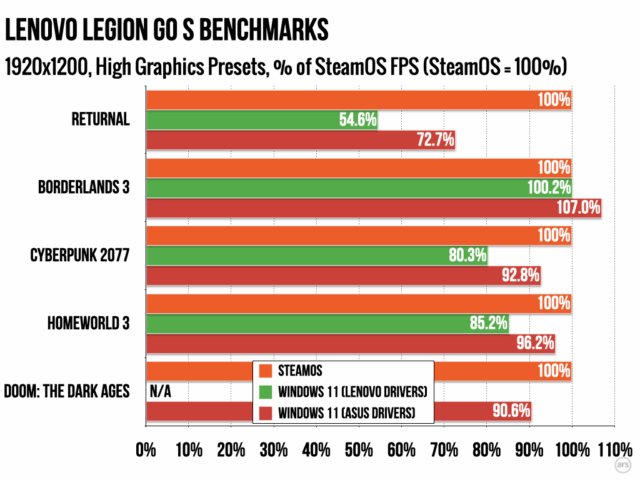
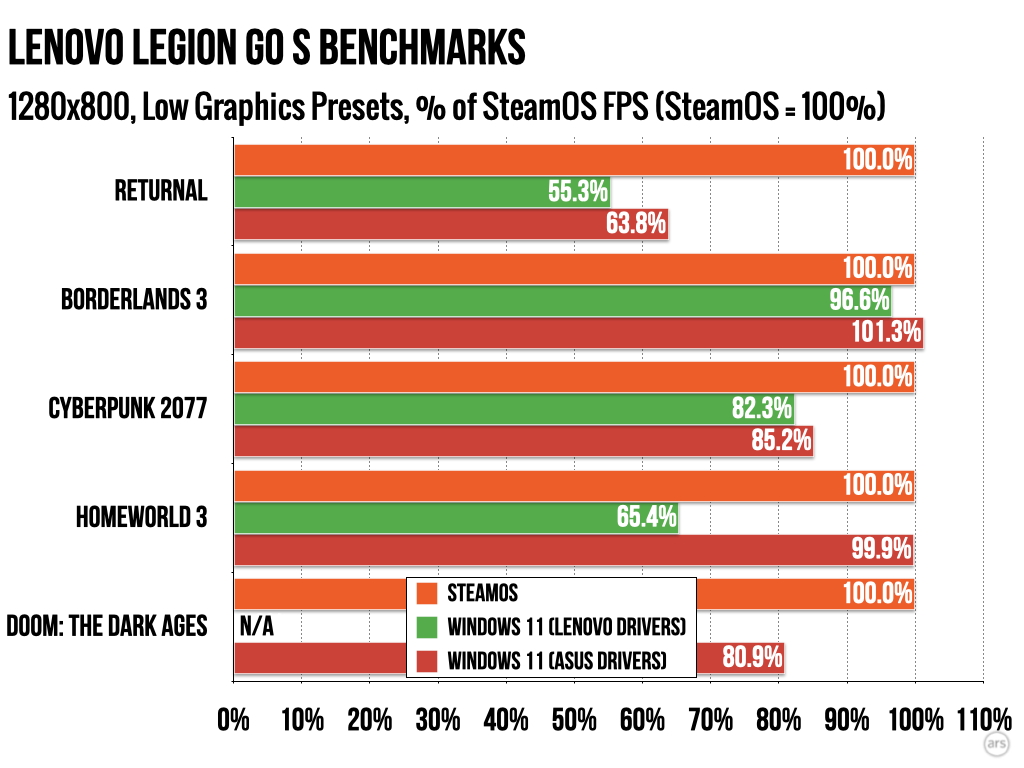
An anonymous reader quotes a report from Ars Technica: Nearly a decade ago, Ars testing found that Valve's "Steam Machines"-era version of SteamOS performed significantly worse than Windows when SteamOS's Linux game ports were tested on the same hardware as their Windows counterparts. Today, though, Ars testing on the Lenovo Legion Go S finds recent games generally run at higher frame rates on SteamOS 3.7 than on Windows 11. [...]

As you can see in the included charts, SteamOS showed noticeable frame rate improvements in four of the five games tested. Only Borderlands 3 showed comparable performance across both operating systems, with Windows eking out ever-so-slightly higher frame rates in that game's benchmarks. For the other four tested games, the stock Lenovo Windows drivers were sometimes significantly worse than those included with SteamOS. When playing Returnal at "High" graphics presets and 1920x1200 resolution, for instance, changing from Lenovo's Windows drivers to SteamOS meant the difference between a hard-to-take 18 FPS average and a downright decent 33 FPS average. Sideloading the updated Asus drivers showed a noticeable improvement in Windows performance across all tested games and even brought Homeworld 3's "Low" graphics benchmark test to practical parity with SteamOS. In all other cases, though, even these updated drivers resulted in benchmark frame rates anywhere from 8 percent to 36 percent lower than those same benchmarks on SteamOS.

These results might seem a bit counterintuitive, considering that games running on SteamOS must go through a Proton translation layer for every native Windows instruction in a game's code. But Valve has put in consistent work over the years to make Proton as efficient and cross-compatible as possible; not to mention its continued work on Linux's Mesa graphics drivers seems to be paying dividends for SteamOS graphics performance. Running SteamOS also means eliminating a lot of operating system overhead that the more generalist Windows uses by default. Microsoft seems aware of this issue for gamers and has recently announced that the upcoming "Xbox Experience for Handheld" will "minimize background activity and defer non-essential tasks" to allow for "more [and] higher framerates" in games.

First Person Shooters (Games)

New 'Doom: The Dark Ages' Already Adjusted to Add Even More Dangerous Demons (windowscentral.com) 23

Doom: The Dark Ages just launched on May 15. But it's already received "difficulty" balance changes "that have made the demons of Hell even more dangerous than ever," writes Windows Central: According to DOOM's official website Slayer's Club, these balance adjustments are focused on making the game harder, as players have been leaving feedback saying it felt too easy even on Nightmare Mode. As a result, enemies now hit harder, health and armor item pick-ups drop less often, and certain enemies punish you more severely for mistiming the parry mechanic.
It reached three million players in just five days, which was seven times faster than 2020's Doom: Eternal," reports Wccftech (though according to analytics firm Ampere Analysis (via The Game Business), more than two million of those three million launch players were playing on Xbox, while only 500K were playing on PS5.") "id Software proves it can still reinvent the wheel," according to one reviewer, "shaking up numerous aspects of gameplay, exchanging elaborate platforming for brutal on-the-ground action, as well as the ability to soar on a dragon's back or stomp around in a giant mech."

And the New York Times says the game "effectively reinvents the hellish shooter with a revamped movement system and deepened lore" in the medieval goth-themed game... Double jumping and dashing are ditched and replaced with an emphasis on raw power and slow, strategic melee combat. Doom Slayer's arsenal features a brand-new tool, the powerful Shield Saw, which Id Software made a point to showcase across its "Stand and Fight" trailers and advertisements. Used for absorbing damage at the expense of speed, the saw also allows players to bash enemies from afar and close the gap on chasms too wide to jump across. While previous titles allowed players to quickly worm their way through bullet hell, The Dark Ages expects you to meet foes head on. "If you were an F-22 fighter jet in Doom Eternal, this time around we wanted you to feel like an Abrams tank," Hugo Martin, the game's creative director, has told journalists.

And Doom Slayer's beefy durability and unstoppable nature does make the gameplay a refreshing experience. The badassery is somehow ratcheted to new heights with the inclusion of a fully controllable mech, which has only a handful of attacks at its disposal, and actual dragons. Flight in a Doom game is entirely surprising and fluid, and the dragons feel relatively easy to maneuver through tight spots. They can also engage in combat more deliberately with the use of dodges and mounted cannons...

One of my favorite additions is the skullcrusher pulverizer. Equal parts heinous nutcracker and demonic woodchipper, the gun lodges skulls into a grinder and sends shards of bones flying at enemies. The animation is both goofy and satisfying.

Another special Times article notes that Doom's fans "resurrect the original game over and over again on progressively stranger pieces of hardware: a Mazda Miata, a NordicTrack treadmill, a French pharmacy sign." But what many hard-core tech hobbyists want to know is whether you can play it on a pregnancy test. The answer: positively yes. And for the first time, even New York Times readers can play Doom within The Times's site [after creating a free account]...

None of this happened by accident, of course. Ports were not incidental to Doom's development. They were a core consideration. "Doom was developed in a really unique way that lent a high degree of portability to its code base," said John Romero, who programmed the game with John Carmack. (In our interview, he then reminisced about operating systems for the next 14 minutes.) Id had developed Wolfenstein 3D, the Nazi-killing predecessor to Doom, on PCs. To build Doom, Carmack and Romero used NeXT, the hardware and software company founded by Steve Jobs after his ouster from Apple in 1985. NeXT computers were powerful, selling for about $25,000 apiece in today's dollars. And any game designed on that system would require porting to the more humdrum PCs encountered by consumers at computer labs or office jobs.

This turned out to be advantageous because Carmack had a special aptitude for ports. All of Id's founders met as colleagues at Softdisk, which had hired Carmack because of his ability to spin off multiple versions of a single game. The group decided to strike out on its own after Carmack created a near-perfect replica of the first level of Super Mario Bros. 3 — Nintendo's best-selling platformer — on a PC. It was a wonder of software engineering that compensated for limited processing power with clever workarounds. "This is the thing that everyone has," Romero said of PCs. "The fact that we could figure out how to make it become a game console was world changing...."

Romero founded a series of game studios after leaving Id in 1996 and is working on a new first-person shooter, the genre he and Carmack practically invented. He has no illusions about how it may stack up. "I absolutely accept that Doom is the best game I'll ever make that has that kind of a reach," he said. "At some point you make the best thing." Thirty years on, people are still making it.

And in related news, PC Gamer reports... As part of a new "FPS Fridays" series on Twitch, legendary shooter designer John Romero streamed New Blood's 2018 hit, Dusk, one of the first and most influential indie "boomer shooters" in the genre's recent revitalization. The short of it? Romero seems to have had a blast.

Slashdot Top Deals