Hardware Hacking

"Nuclear Archaeology" Inspires Replica of Hiroshima's Little Boy 298

James Cho writes "Through a decade of painstaking reverse engineering, trucker John Coster-Mullen built the first accurate replica of the Hiroshima bomb. His work yielded a new history of the first nukes, 'Atom Bombs: The Top Secret Inside Story of Little Boy and Fat Man,' with historian Robert Norris saying, 'Nothing else in the Manhattan Project literature comes close.' Philip Morrison, one of the physicists who helped invent the bomb, deemed it 'a remarkable job.'"
Hardware Hacking

New Connections For Stretchable, Twistable Electronics 60

tugfoigel writes "Jizhou Song, a professor in the University of Miami College of Engineering and his collaborators Professor John Rogers, at the University of Illinois and Professor Yonggang Huang, at Northwestern University have developed a new design for stretchable electronics that can be wrapped around complex shapes, without a reduction in electronic function. The new mechanical design strategy is based on semiconductor nanomaterials that can offer high stretchability (e.g., 140%) and large twistability such as corkscrew twists with tight pitch (e.g., 90 degrees in 1 cm). Potential uses for the new design include electronic devices for eye cameras, smart surgical gloves, body parts, airplane wings, back planes for liquid crystal displays and biomedical devices."
Displays

DIY LED Array Marquee For Your PC 128

An anonymous reader writes "Ever wish you had one of those big LED displays to keep you up to date on e-mails, stock quotes, server uptimes, or weather? Here's a new video tutorial showing how to build your own computer-controlled LED array. You can code your own data feed, and just send it over a TCP socket. This looks like a fun weekend project for someone looking to get started with electronics by building something useful."
Hardware Hacking

Most Hackable Coupon-Eligible DTV Converter? 479

An anonymous reader writes "So I've finally gotten my DTV coupons, now I have to choose a converter before the analog signals go dark. I'd like to get one that is hackable, but haven't had much luck finding information about the internals of the units available. My question is: What chipsets do the different coupon eligible converters use, and which one is the most hackable? It'd be great to be able to send my own MPEG stream and have it displayed, or to grab the raw stream out of the device."
Hardware Hacking

A Sony Camera Running Linux 209

jonr writes "At the recently concluded Consumer Electronics Show, Sony presented the new camera from its Cyber-shot product line. The DSC-G3 comes with a Zeiss lens with 4x zoom, a large 3.5" touch display, and 4GB of internal memory. Most interesting is the camera's software that includes, among other things, face and scene recognition, based on Busybox and Kernel 2.6.11 for the Access Linux Platform. The camera also has built-in Wi-Fi."
Hardware Hacking

A TV Show Based On MAKE Magazine 109

ptorrone writes "Make: television debuted online and on public television (broadcast / cable tv). The series encourages everyone to invent, reinvent, recycle, upcycle, and act up. Based on the popular Make magazine, each half-hour episode hopes to inspire viewers to think, create, and, well, make. Each episode can be viewed or downloaded DRM-free, in HD on makezine.tv — the show is also available on Vimeo, YouTube, blip.tv and iTunes."
Communications

CCC Hackers Break DECT Telephones' Security 116

Sub Zero 992 writes "Heise Security (article in German) is reporting that at this year's Chaos Communications Congress (25C3) researchers in Europe's dedected.org group have published an article (PDF) showing, using a PC-Card costing only EUR 23, how to eavesdrop on DECT transmissions. There are hundreds of millions of terminals, ranging from telephones, to electronic payment terminals, to door openers, using the DECT standard." So far, the Heise article's German only, but I suspect will show up soon in English translation. Update: 12/30 21:27 GMT by T : Reader Juha-Matti Laurio writes with the story in English. Thanks!
Hardware Hacking

DIY USB Servo-Guided Water Gun 66

An anonymous reader writes "What better way is there to learn something than by making your own DIY gadget? Here's a new video showing how to use a common hobby servo, in conjunction with a small water pump, to create a USB controlled water gun! You can use your keyboard to aim and fire at an unsuspecting passerby. Both fun and educational, this project looks like a great DIY weekend project for any IT guy, wanting to make sure people think twice before asking a stupid question!"
Earth

Scientists Build Neonatal Incubator From Car Parts 211

Peace Corps Online writes "The NYTimes ran a story this week about a group of scientists who have built a neonatal incubator out of automobile parts, including a pair of headlights as a heat source, a car door alarm to signal emergencies, and an auto air filter and fan to provide climate control. The creators of the car-parts incubator say that an incubator found in any neonatal intensive care unit in the US could cost around $40,000, but the incubator they have developed can be built for less than $1,000. One expert says as many as 1.8 million infants might be spared every year if they could spend just a week in the units, which help babies who are born early or at low birth weights regulate their body temperature until their organs fully develop. Experts say in developing countries where infant mortality is most common, high-tech machines donated by richer nations often conk out when the electricity fizzles or is restricted to conserve power. 'The future medical technologists in the developing world,' says Robert Malkin, director of Engineering World Health, 'are the current car mechanics, HVAC repairmen, bicycle shop repairmen. There is no other good source of technology-savvy individuals to take up the future of medical device repair and maintenance.'"
Hardware Hacking

Scientists Hack Cellphone To Detect Diseases 100

Dave Bullock (eecue) plugs his piece up at Wired on a cellphone modded into a portable blood tester. This could become a significant piece of medical technology. "A new MacGyver-esque cellphone hack could bring cheap, on-the-spot disease detection to even the most remote villages on the planet. Using only an LED, plastic light filter, and some wires, scientists at UCLA have modded a cellphone into a portable blood tester capable of detecting HIV, malaria, and other illnesses. Blood tests today require either refrigerator-sized machines that cost hundreds of thousands of dollars or a trained technician who manually identifies and counts cells under a microscope. These systems are slow, expensive and require dedicated labs to function. And soon they could be a thing of the past."
Education

Cornell University FPGA Class Projects for 2008 112

Matt writes "The new crop of Cornell University ECE 5760 projects are now online. Some really cool projects, as well as the previous two years' worth of projects." Since it's mid-December, many other schools, too, have either just let out or are about to; can you point to any other online collections of cool technical projects?
Hardware Hacking

Photos of the Damage To the Large Hadron Collider 106

holy_calamity writes "CERN have released images of the damage done to the world's most powerful machine, the Large Hadron Collider, when an electrical fault caused a helium leak. New Scientist has posted them, along with explanations of what you can see. The sudden burst of gas shifted some of the huge superconducting magnets by half a meter, causing at least $21 million in damage."
Hardware Hacking

An Open Source Coffee Machine 99

An anonymous reader writes "The Open Source Coffee Machine [video link] is a recycled coffee machine, controlled by a PC running Beremiz, and using some MicroMod CANopen I/O nodes from Peak-System. This machine have been prepared by Peak-System and Lolitech for SCS-Paris-08 exhibition. It served free coffee during four days at Peak-System's booth, and has been donated to IUT of Saint-Dié-des-Vosges, France, so that students can have fun practicing automation."
Hardware Hacking

DMCA Exemptions Desired To Hack iPhones, Remix DVDs 188

An anonymous reader writes "For copyright activists, Christmas comes but once every three years: a chance to ask Santa for a new exemption to the much-hated Digital Millennium Copyright Act's prohibitions against hacking, reverse engineering and evasion of Digital Rights Management (DRM) schemes protecting all kinds of digital works and electronic items. Judging from the list of 20 exemptions requested this year [19 shown], some in the cyber-law community are thinking big. The requests include the right to legally jailbreak iPhones in order to use third party software, university professors wishing to rip clips from DVDs for classroom use, YouTube users wishing to rip DVDs to make video mashups, a request to allow users to hack DRM protecting content from stores that have gone bankrupt or shut down, and a request to allow security researchers to reverse engineer video games with security flaws that put end-users at risk." Reader MistaE provides some more specific links to PDF versions: "Among the exemption proposals is a request from the Harvard Cyberlaw Clinic to allow circumvention of DRM protection when the central authorization server goes down, a request from the EFF to allow circumvention to install third party programs on phones, as well as a request for ripping DVDs for non-commercial purposes. There were also several narrow requests from educational institutions to rip DVDs for classroom practices."
Hardware Hacking

The State of Open Source Hardware In 2008 88

ptorrone writes "MAKE Magazine has put together their 3rd annual 'State of Open Source Hardware 2008' — in just a few years, the number of projects has grown from a small handful to an amazing 60+ offerings. Similar to open source software, open source hardware is available with source code, schematics, firmware and bills of materials, and allows commercial use. The most popular project, Arduino, the open source prototyping platform for artists and engineers, has shipped over 60,000 units." The article is formatted such that the first link for a particular device will usually take you to the project home page. Some will bring you instead to where you can purchase the items, but most still have a "How To" tab which will direct you to guides and instructions on how to build your own gadgets. There are a bunch of interesting devices, from the Game of Life on the outside of a cube to a home-made MP3 player to OpenMoko.
Hardware Hacking

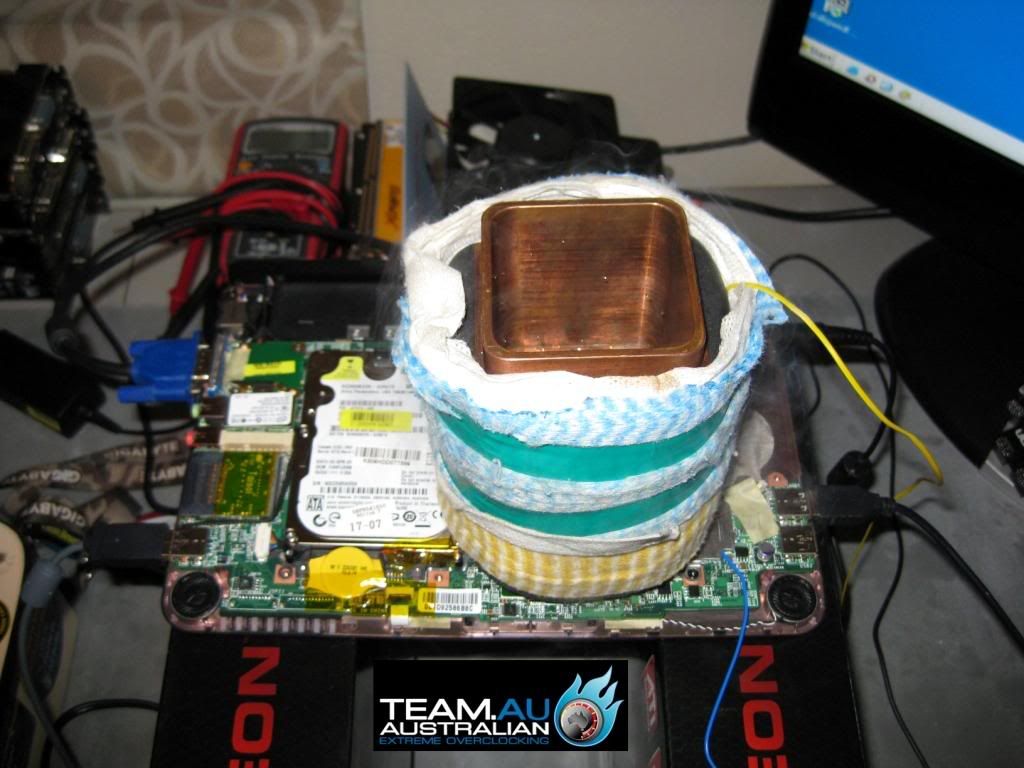
MSI Wind U100, Overclocked With Liquid Nitrogen 95

james writes "What do you get when you combine a MSI Wind U100 notebook with liquid nitrogen? The new Intel Atom frequency World Record ... and some damn cool pictures! A large copper pot is used, sitting on top of the GPU and chipset, and cold transfer through the original heatsink plate to the CPU. This was cooled down to about -20 C to achieve the new world mark. (Intel Atom N270 @ 2315mhz) For more information you can check out the original forum thread.
Hardware Hacking

History of the LED — the Movie 106

ptorrone writes "MAKE Magazine has a fantastic 'Connections'-style video called THE LED — The short documentary has the history of the LED to modern day applications. Starting with the work of Russian Oleg Vladimirovich Losev, which was largely ignored in the 1920s, to making your own 'Cat's Whisker' — a primitive LED made from a metal-semiconductor point-contact junction forming a Schottky barrier diode. The first practical visible-spectrum LED was developed in 1962 by Nick Holonyak Jr., while working at General Electric Company."
Hardware Hacking

Hacks Allowing Disabled Gamers To Play Guitar Hero 94

angrymilkman writes "Here are two interesting new approaches where researchers modified the popular Guitar Hero game so it can be played by gamers with disabilities. Air Guitar Hero modifies the Guitar Hero controller so someone without limbs can play it by using electrodes attached to the user's residual arm. Blind Hero is a mod for Frets on Fire that uses a haptic glove that can turn visual feedback into haptic feedback, allowing blind gamers to play Guitar Hero songs." There have been a variety of Guitar Hero hacks in the past, including a custom drum pad for playing the guitar part, using the plastic guitar as a real instrument, and rocking out with your bike, but it's nice to see some more serious modifications showing up.
Hardware Hacking

A Replica of the First 4004 Calculator 63

mcpublic writes "For the 37th anniversary of Intel's 4004, the world's first off-the-shelf, customer-programmable microprocessor, vintage computer enthusiast Bill Kotaska has successfully built a replica of Busicom's historic 141-PF printing calculator using vintage Intel chips. Decades before the ubiquitous 'Intel inside' sticker, Japanese calculator maker Busicom introduced the first product ever built around an Intel microprocessor. Bill's homebrew replica includes a rare Shinshu Seiki Model-102 drum printer and runs firmware extracted from the original Busicom ROMs. Schematics and photos of his re-creation are available at the unofficial 4004 web site, along with Tim McNerney's new PIC-based emulator of the Model-102 printer. The site includes the Busicom 'source code,' 4004 details, interactive simulators, and other goodies for students, engineers, and computer historians." We discussed the 36th 4004 anniversary project here last year.
Hardware Hacking

DNA Strands Modified Into Tiny Fiber-Optic Cables 113

holy_calamity writes "New Scientist reports on the latest idea from researchers trying to make microcomputers use photons in place of electrons — to make optical interconnects from strands of DNA. Mixing DNA strands with the right dye molecule upgrades them into wires for light, like microscopic optical fibers, able to absorb photons at one end and transmit them to the other. One of the neat things about using DNA is it is the right scale to play nicely with existing and future chip lithography. Quoting: 'The result is similar to natural photonic wires found inside organisms like algae, where they are used to transport photons to parts of a cell where their energy can be tapped. In these wires, chromophores are lined up in chains to channel photons.'"

Slashdot Top Deals